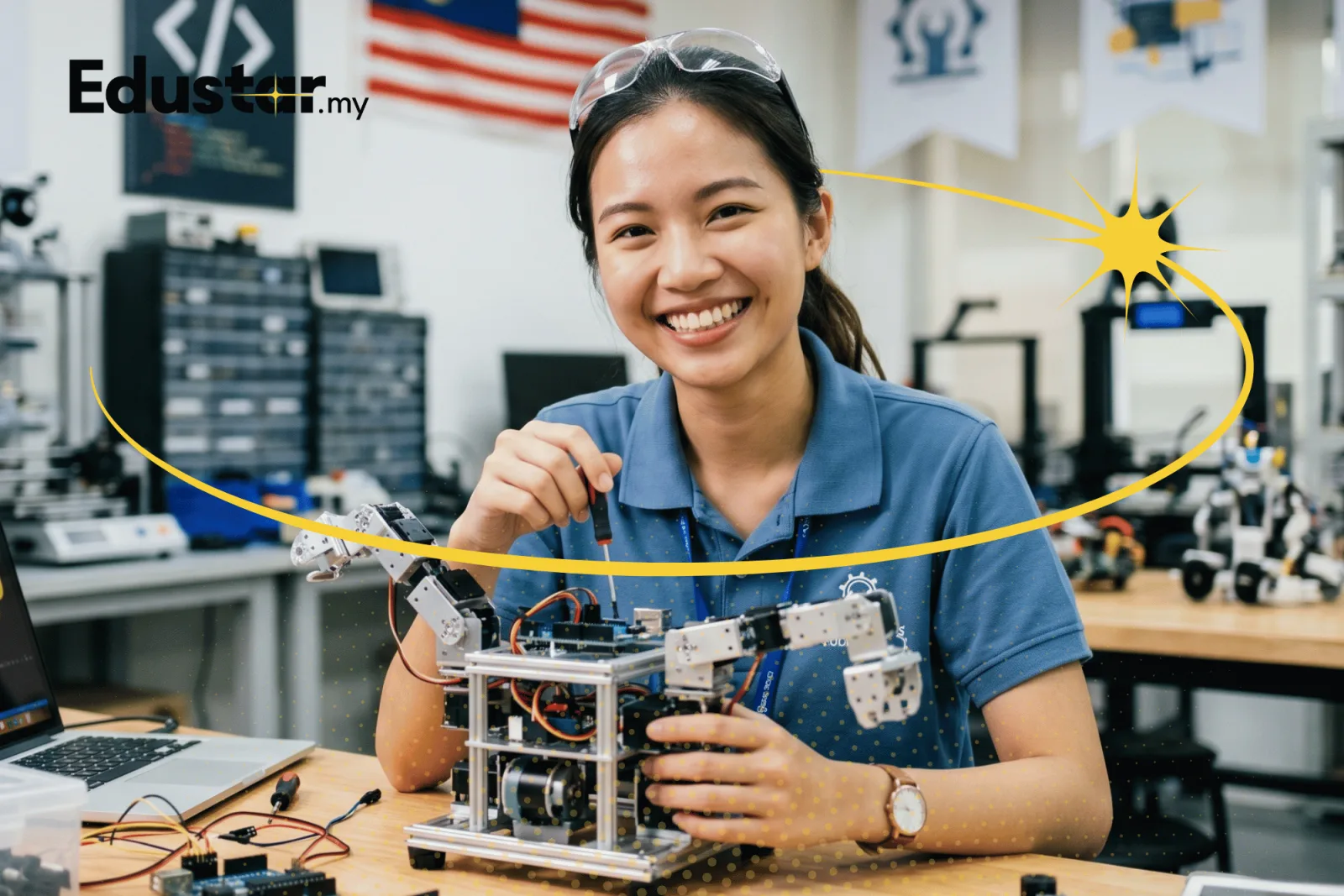
Programming & Coding Tuition in Malaysia
Programming and coding tuition in Malaysia means structured one-to-one coaching that tracks the KPM-aligned route: Scratch 3.0 in Year 4-6 through #mydigitalmaker, Python for SPM Sains Komputer 4571, Cambridge pseudocode for IGCSE Computer Science 0478, Cambridge A-Level 9618, and C++ for MyMOI / IOI. Coaches drill computational thinking, a disciplined Git/GitHub portfolio, and hands-on project building once the syntax sits steady.
What is Programming & Coding Tuition?
Programming and coding tuition in Malaysia stretches from primary school right through to a first job. It opens at KSSR Year 4-6 with Scratch 3.0 (MIT) inside #mydigitalmaker (KPM + MDEC), carries on through KSSM Form 1-3 Asas Sains Komputer, and reaches SPM Sains Komputer paper code 4571, which is sat in Python 3 (LPM, KSSM DSKP). International learners work through Cambridge IGCSE Computer Science 0478 (Paper 1 Theory with Paper 2 Algorithms and Programming, written in Cambridge pseudocode notation) and the Cambridge International A-Level 9618 in Computer Science (four papers, Python / Java / VB.NET), while STPM-stream students sit STPM ICT 958 (MPM, 3-semester). Competition-minded students join the MyMOI (Malaysian Olympiad in Informatics) route, which Persatuan Sains Komputer Malaysia administers, leading to IOI in C++. The university stage then feeds MQA-accredited CS degrees at the Premier Digital Tech Institutes that MDEC lists (MMU, APU, Taylor's, Sunway), plus public-university IPTA such as UM, USM, UKM, UPM, UTM and UTeM. Working adults and career-changers may lodge a claim through HRD Corp when their employer is registered. Edustar pairs every learner with a tutor who teaches whatever language the exam expects: Python for SPM, pseudocode habit for IGCSE, C++ for the olympiad, plus computational thinking (breaking problems apart, reading patterns, abstraction, and designing algorithms) and a Git/GitHub portfolio routine from session one.
- 01SPM Sains Komputer 4571 is sat in Python 3 (KPM/LPM, KSSM DSKP). Paper 1 theory, then Paper 2 practical programming plus SQL
- 02Cambridge IGCSE Computer Science 0478 runs on Cambridge pseudocode with flowcharts; the coding language may be Python, Java or VB
- 03Cambridge A-Level Computer Science 9618 spans four papers; Python / Java / VB.NET are all allowed on Paper 2 / Paper 4
- 04MyMOI (Malaysian Olympiad in Informatics), organised through Persatuan Sains Komputer Malaysia, is coded in C++; the route ends at an IOI team of 4
- 05Junior start: Scratch 3.0 (MIT, free, with a BM-localised UI) for Year 4-6 through #mydigitalmaker (MDEC + KPM since 2016)
- 06For parents choosing a CS degree, the Premier Digital Tech Institutes (PDTI) that MDEC recognises span MMU, APU, Taylor's, Sunway, UTM, USM, UKM, UM and UTeM
- 07Early tooling we introduce: Git and GitHub for version control, VS Code for editor fluency, and the Python REPL for instant feedback
- 08Adults may recover the cost through HRD Corp when their levy-paying employer qualifies, and bootcamp-style tracks fit this best
- 09Edustar tutors keep to pair-programming mode, with tutor and student sharing one keyboard as the code takes shape
What Programming & Coding tuition with Edustar covers
The plain scope: steady coding coaching all year across the entire MY pathway, with no grade and no job promised.
Year 4 – Adult
All-ages pathway supported
5 exam tracks
SPM 4571, IGCSE 0478, A-Level 9618, STPM 958, MyMOI
5 languages
Scratch, Python, JavaScript, C++, plus Cambridge pseudocode
Nationwide
In-person or online
What programming and coding tuition covers
Three modules laid over the Malaysian coding route: a junior pipeline (Scratch with Python basics), an exam track (SPM 4571 / IGCSE 0478 / A-Level 9618), and an olympiad-plus-portfolio strand (MyMOI with project repos on GitHub).
Junior pipeline (Year 4-6 → Form 1-3): Scratch 3.0 + Python basics
A move from block-based to text-based coding, laid over KSSR Reka Bentuk dan Teknologi and KSSM Asas Sains Komputer. The aim is a computational-thinking and project habit well before SPM 4571.
Scratch 3.0 (MIT, free, browser-run, UI localised in BM) comes first: sprites and events, then loops and conditionals, broadcast messages, variables and lists, alongside 3-5 Scratch pieces for the portfolio (an animation, a quiz, a small game). Learners tackle #mydigitalmaker challenges and KPM-endorsed Scratch material. Python 3 follows: turtle graphics, input/print, if/elif/else, for and while loops, lists and dictionaries, functions, and simple file I/O. The computational-thinking frame (Wing 2006) is introduced here as abstraction, decomposition, pattern-reading and algorithm design. App Inventor (MIT) gets a look for mobile prototyping. Git basics land too: init, add, commit and a first push to a public GitHub repo. Algorithm vocabulary arrives gently: sort, search, recursion. This module suits KSSR Year 4-6, Form 1-3 Asas Sains Komputer under KSSM, and IGCSE / IB primary learners.
Exam-track (Form 4-5 SPM 4571 / IGCSE 0478 / A-Level 9618 / STPM 958)
Exam-focused coaching set to the correct language and notation for each board: Python for SPM 4571, Cambridge pseudocode for IGCSE 0478, and every one of the four papers for A-Level 9618.
SPM Sains Komputer 4571 (KPM/LPM, KSSM DSKP) breaks into Paper 1 (theory MCQ and structured items on computer systems, networking, data representation and algorithm design) and Paper 2 (hands-on Python programming with database SQL: SELECT, INSERT, UPDATE, DELETE, JOIN, normalisation to 3NF, ERD). Python 3 goes deeper into classes, exception handling, list comprehensions, lambda and modules. For Cambridge IGCSE Computer Science 0478 the split is Paper 1 Theory (data representation, communication and networking, hardware, software, security, ethics, 1h 45min) and Paper 2 Algorithms, Programming & Logic (Cambridge pseudocode notation, trace tables, flowcharts, and a programming task in the chosen language, 1h 45min). The four-paper A-Level 9618 in Computer Science from Cambridge covers Paper 1 Theory Fundamentals, Paper 2 Fundamental Problem-solving & Programming Skills, Paper 3 Advanced Theory (OOP, recursion, data structures, low-level programming, declarative and functional paradigms) and Paper 4 Practical. STPM ICT 958 (MPM, 3-semester) serves the STPM-stream pre-U. Exam craft rounds it off: pseudocode-to-code translation, trace-table fluency, dry-running algorithms, and structured answers written to the LPM / Cambridge mark scheme.
Olympiad + portfolio + adult bootcamp (MyMOI / IOI + GitHub + HRD Corp tracks)
The advanced strand. Competitive MyMOI programming in C++ for olympiad-bound students, a full project portfolio backed by public GitHub repos for university applications, and bootcamp-style coaching for adults and career-changers with an HRD Corp claim where the employer qualifies.
MyMOI (Malaysian Olympiad in Informatics), overseen by Persatuan Sains Komputer Malaysia, moves MyMOI Open → MyMOI Selection → an IOI team of 4. The contest language is C++, the de facto IOI standard. The topic map: greedy algorithms, dynamic programming (1D / 2D / bitmask DP), graph algorithms (BFS, DFS, Dijkstra, Floyd-Warshall, MST, topological sort), data structures (segment tree, Fenwick tree / BIT, disjoint set union, treap), string algorithms (KMP, Z-function, suffix array), and number theory (modular arithmetic, CRT, Möbius). Training runs in partnership with USM School of Computer Sciences and UM FCSIT under Akademi Sains Malaysia. On the portfolio and career side: 3-5 solid GitHub repositories (a full-stack web app in React + Node.js or Next.js, a Python data project, a CLI tool), README discipline, deployment to Vercel / Netlify / Render, and light CI/CD through GitHub Actions. The adult / HRD Corp track (RM 0 out of pocket once the employer claims) covers full-stack JavaScript (HTML/CSS/JS → React → Node.js → PostgreSQL), Python data with ML basics (NumPy, Pandas, scikit-learn), and certification prep for AWS / Azure / Google Cloud. It suits Form 4-5 olympiad aspirants, university-bound CS students building an admission CV, IPTA / PDTI freshers crossing into industry, and adult career-changers.
Who Programming & Coding tuition in Malaysia is for
We set the coach, the language and the pace to the learner's real starting point: a Year 4 Scratch beginner, a Form 4 SPM 4571 candidate, an IGCSE / A-Level CS student, or an adult changing careers.
Primary school Scratch beginners (Year 4-6)
This is the doorway into the junior pipeline. The child is curious about computers, often having met Scratch through #mydigitalmaker at school, and the parent wants a steady progression ahead of the odd one-off activity. Coaching builds a computational-thinking habit (reading patterns, decomposition, abstraction, algorithm design), produces 3-5 Scratch portfolio pieces, and slides into Python turtle graphics by the close of Year 6, all lined up with KSSR Reka Bentuk dan Teknologi.
- School touches Scratch now and then; the child plateaus and is hungry for more depth
- Parent is unsure whether to open with Scratch, with Python, or to skip to 'real coding'
- Concern that unstructured screen time turns unproductive
- No obvious next move once the child wraps up the school's Scratch starter projects
Form 4-5 students preparing for SPM Sains Komputer 4571
The KSSM upper-secondary exam track. The student has taken Sains Komputer as an SPM elective (frequently next to Add-Math 3472 and Physics 4531) and needs Python 3 fluency for Paper 2 practical programming plus database SQL. Coaching runs the full DSKP topic list, drills past papers in the official LPM format, and builds trace-table and pseudocode-to-Python translation discipline.
- Python syntax feels comfortable while the Paper 2 SQL section (SELECT / JOIN / normalisation) stays unfamiliar
- The school Sains Komputer teacher's pace is too slow or too uneven for SPM exam-format prep
- Revision for Add-Math 3472, Physics 4531 and Chemistry 4541 crowds the timetable, so coaching has to be tight and targeted
- Wants a public GitHub portfolio ready for STPM ICT 958 and PDTI CS degree applications
IGCSE / A-Level Computer Science students (0478 / 9618)
The international-curriculum track across MY private and international schools (Tenby, Cempaka, Sri KL, Garden, ELC, Sayfol). The student needs Cambridge pseudocode discipline for IGCSE 0478 Paper 2 plus Python / Java / VB.NET implementation skill, then OOP, recursion, data structures and advanced theory for A-Level 9618 Papers 3 and 4. The coach has to know the Cambridge mark scheme alongside the KPM one.
- Theory is covered well at school while Paper 2 algorithm-design timing feels rushed
- Cambridge pseudocode notation (DECLARE, ENDPROCEDURE, FOR...NEXT) reads differently from Python and needs deliberate practice
- A-Level 9618 Paper 4 Practical demands sustained project work, and school lab time is limited
- Aiming at top-tier CS admission in the UK, AU, SG or elsewhere, which calls for a strong portfolio and olympiad credentials
University-CS-bridging students + adult career-changers
Two cohorts share one segment. The pre-U or fresher has just finished STPM / IGCSE / A-Level / IB and holds a place at IPTA (UM, USM, UKM, UTM) or PDTI (Sunway, Taylor's, MMU, APU), and wants to reach Year 1 already fluent in Python, C++ and Git / GitHub, ahead of the cohort. The adult career-changer, 25-40 and in a non-tech role, is weighing a dev career and can claim through HRD Corp via their employer. Coaching leans on project velocity (3-5 deployed GitHub projects inside 6 months), language depth (full-stack JavaScript or Python data) and interview prep.
- First-year IPTA / PDTI CS lectures assume some coding already, so pre-coursework keeps the student afloat
- Adult learner with limited evening time, looking for tight targeted coaching in place of a 12-week bootcamp
- Unsure how the HRD Corp claim runs through the employer's L&D budget
- Needs a portfolio that wins a first dev internship or role, weighted toward repos over certificates
From first call to first programming lesson
How Programming & Coding tuition with Edustar gets going: language and pace set to the exam track, with project and portfolio work carried right through the year.
- 1
Free needs assessment (Day 0)
Tell us the learner's current stage (Year / Form / adult), any prior coding exposure (Scratch projects, a school Sains Komputer mark, existing GitHub work), the target exam (SPM 4571 / IGCSE 0478 / A-Level 9618 / STPM 958 / MyMOI / none), the target language (Python / pseudocode / C++ / JavaScript), and the timeframe. We say plainly what the available window can realistically deliver.
~15 min - 2
Diagnostic, short coding task at level
A level-appropriate diagnostic: a short Scratch brief for Year 4-6, a Python function-writing task for Form 1-3, then a past-year SPM 4571 Paper 2 question (Python + SQL) for Form 4-5, a Cambridge IGCSE 0478 Paper 2 pseudocode question for the IGCSE track, and a competitive-programming problem in C++ for MyMOI aspirants. We read current fluency, debugging instinct and computational thinking, weighing how the learner works as much as the answer they reach.
Before lesson 1 - 3
Coach matching (language-specialist)
We line up a coach for the exact exam and language: Python with the KPM mark scheme for SPM 4571; Cambridge pseudocode plus Python/Java for IGCSE 0478; the full Cambridge syllabus for A-Level 9618; STPM ICT 958 (MPM) for the STPM stream; C++ and competitive programming for MyMOI / IOI; full-stack JavaScript or Python data for adult and portfolio tracks. A specialist pairing keeps the learner off the wrong language and saves the wasted weeks.
1-3 days - 4
First lesson, environment + Git setup + Lesson 1 task
The coach helps set up VS Code, Python 3 / Node.js / G++ as needed, and a personal GitHub account. Lesson 1 pushes the first 'hello world' commit to a public repo. The computational-thinking frame gets laid out early: decomposition, abstraction, pattern-reading and algorithm design. Pair-programming sets in from minute one, with tutor and student both at the keyboard.
Lesson 1 - 5
Weekly practice, working through the curriculum topic by topic
Sessions of 1.5-2 hours each week build around the chosen curriculum module: Scratch with Python basics for juniors, KSSM Asas Sains Komputer for Form 1-3, the full SPM 4571 DSKP for Form 4-5, the complete Cambridge 0478 / 9618 for IGCSE / A-Level, and MyMOI competitive-programming topics in C++ for olympiad aspirants. Every week the student pushes a commit to GitHub until version control becomes second nature.
Ongoing, 8-12 weeks per module - 6
Project sprint + past-paper drilling
Mid-module: a 2-3 week mini-project sprint that ships a deployed artefact (a Python game, a Flask web app, a Scratch animation, a full-stack React + Node mini-app, or a competitive-programming solution set). For exam-track students, the final 4-6 weeks turn to past-paper work in the official format: LPM SPM 4571 past papers, Cambridge IGCSE 0478 past papers, A-Level 9618 past papers, and MyMOI past contest problems.
Mid-module (project) + final 4-6 weeks pre-exam (past-paper) - 7
Exam-day prep + post-module portfolio review
Close to exam day, timed mock papers run under official conditions (SPM 4571 Paper 1 and Paper 2, IGCSE 0478 Papers 1 and 2, A-Level 9618 Papers 1-4). After the module, we go over the GitHub portfolio for README polish, deployment links and a demo video for university applications, then plan the next module (for example Form 4 SPM 4571, then Form 5 final-year polish, then STPM 958 / A-Level 9618 / a PDTI CS application).
Final 1-2 weeks + post-module review
Things parents ask us first
SPM 4571 examines in Python; IGCSE 0478 examines in Cambridge pseudocode
Among MY parents, this is the question that comes up more than any other. SPM Sains Komputer paper code 4571 (KPM/LPM, KSSM DSKP) is sat in Python 3, and Paper 2 brings together practical Python programming and database SQL. Cambridge IGCSE Computer Science 0478 works differently: it asks for fluency in Cambridge pseudocode notation (Paper 2 Algorithms, Programming & Logic). Students still write code in Python, Java or VB.NET during centre prep, though the marking scheme rewards pseudocode discipline. Moving from KPM SK to IGCSE CS means picking up the pseudocode habit; going the other way means learning Python syntax. Edustar sets the coach to the correct exam track from lesson 1.
MyMOI 3-round selection pipeline to IOI (in C++)
The Malaysian Olympiad in Informatics (MyMOI), coordinated by Persatuan Sains Komputer Malaysia, drives the IOI selection. Round 1 is MyMOI Open, an entry-level online round. Round 2 is MyMOI Selection, a competitive programming paper pitched at training-camp invitation level. Round 3 is the training camp itself at USM School of Computer Sciences or UM FCSIT, where the final cut produces the MY IOI team of 4 (coordinated under Akademi Sains Malaysia). The contest runs in C++, so even though school SPM 4571 is in Python, olympiad-bound Form 4-5 students carry both languages. We talk this through plainly at the free consultation.
Scratch → Python → C++ progression mirrors cognitive load
The MY coding progression that works: Scratch 3.0 (Year 4-6, KSSR Reka Bentuk dan Teknologi with #mydigitalmaker), then Python 3 (Form 1-3 Asas Sains Komputer KSSM, Form 4-5 SPM 4571), then C++ (only for those heading to MyMOI / IOI). Block-based Scratch strips away syntax friction so children can sit with logic, sequencing and event-handling. Python stays forgiving (whitespace-delimited, dynamically typed) and remains the school exam language all the way to SPM. C++ arrives for olympiad pace and precision, and only when the student is on the MyMOI track. Older beginners can skip Scratch and open at Python in Form 1; opening at C++ is seldom the right first language.
The MY university shortlist: Premier Digital Tech Institutes (PDTI) under MDEC
When parents ask which MY university fits Computer Science, the practical answer is the set MDEC recognises as Premier Digital Tech Institutes (PDTI). That group right now takes in MMU (Multimedia University), APU (Asia Pacific University), Taylor's and Sunway, together with public IPTA UTM, USM, UKM, UM and UTeM. Graduates from these institutions get a fast lane into the Malaysia Digital ecosystem. Their MQA-accredited CS degrees admit on STPM (Math T 954 is the usual requirement, CGPA 3.00+), Matrikulasi, A-Level 9618, IB DP, or a recognised Foundation / Diploma. Edustar can time your child's coding coaching to reach the STPM / IGCSE / A-Level / IB grade the target university wants.
MyDigital 2030 signals real demand, without promising a job
The MyDigital Blueprint (MOSTI, 2021-2030) sets a target of around 500,000 digital workers by 2025-2030, a published demand signal that sits behind both the SPM 4571 syllabus refresh and the PDTI rationale. Coding skill really does open doors in MY on the back of it. Nothing here guarantees a job, though: results ride on portfolio depth, a visible GitHub track record, internship time and steady learning. Edustar coaches push public GitHub repositories from Form 4 onward, since a CV made of code carries more weight than any certificate.
Adult coding tracks can be HRD Corp claimable, subject to your employer
If an adult is employed at a company that HRD Corp has on its register, the coding tuition may be reclaimable. The levy is generally paid by businesses with annual revenue above RM 2.5M or headcount above 10. The reclaimable items are the adult-track ones: programming bootcamps and certification prep for AWS, Azure, Google Cloud or Cisco. To keep the paperwork simple, we pass your L&D or HR contact a written outline of module hours, learning outcomes and tutor background. The exception to note: school-age SPM 4571 or IGCSE 0478 tuition falls outside this and stays a school-fee or out-of-pocket cost.
Edustar 1-to-1 coding coach vs school Kelab Komputer vs 3-month coding bootcamp vs self-study (freeCodeCamp + Codecademy)
Four routes into coding in Malaysia, set next to each other. Plenty of committed learners run two at once, and the one that should take the lead depends on the learner's age and aim.
Edustar 1-to-1 coding coach
Format
Weekly 1-to-1 pair-programming, year-round, exam-track customised (SPM 4571 / IGCSE 0478 / A-Level 9618 / MyMOI)
Best for
SPM 4571 / IGCSE 0478 / A-Level 9618 students; MyMOI aspirants; portfolio-builders for IPTA / PDTI CS admission
Per-hour or total cost (MYR)
RM 80-220 / hr depending on subject (SPM 4571 mid, IGCSE 0478 and A-Level 9618 upper, MyMOI in C++ upper)
Language(s) taught, match to MY exam
Calibrated: Python for SPM 4571, pseudocode + Python for IGCSE 0478, Python/Java/VB.NET for A-Level 9618, C++ for MyMOI
Portfolio + Git / GitHub discipline
GitHub repo from week 2; 3-5 substantial public projects by Form 5 / year-end
Parent / employer visibility
Weekly WhatsApp progress update; quarterly milestone review; portfolio link shared
School Kelab Komputer / Sains Komputer co-curricular
Format
Weekly co-curricular club, mixed-ability group of 15-30
Best for
Initial exposure; discovering whether coding suits the student
Per-hour or total cost (MYR)
Free (school co-curricular)
Language(s) taught, match to MY exam
Often Python (post-2019 syllabus); occasionally still on older Visual Basic / HTML from ICT 3765 era
Portfolio + Git / GitHub discipline
Variable; rarely structured around public portfolio
Parent / employer visibility
End-of-term Kelab report; informal teacher contact
3-month coding bootcamp (adult, full-time)
Format
Adult-only, full-time and immersive across 12 weeks (Mon-Fri, 9-5)
Best for
Career-changers; adults targeting first dev job in 6-12 months
Per-hour or total cost (MYR)
RM 8,000-18,000 for the full 12 weeks; an employer may support an HRD Corp claim
Language(s) taught, match to MY exam
Usually JavaScript full-stack (React, Node.js); does not cover SPM 4571 or IGCSE 0478
Portfolio + Git / GitHub discipline
Strong; bootcamp graduates leave with 3-5 deployed projects + capstone
Parent / employer visibility
Cohort dashboard + final demo day for hiring partners
Self-study (freeCodeCamp + Codecademy + The Odin Project)
Format
Online at your own pace, with Discord community help and no live coach on hand
Best for
Very self-directed learners who read English comfortably and stay disciplined
Per-hour or total cost (MYR)
RM 0 to ~RM 500 / year (premium tier subscriptions)
Language(s) taught, match to MY exam
Whatever path the learner picks; no MY exam alignment
Portfolio + Git / GitHub discipline
As strong as the learner makes it; no external accountability
Parent / employer visibility
None unless self-reported
Where Programming & Coding tuition sits along the Malaysian pathway
From Year 4 Scratch through #mydigitalmaker to MyMOI / IOI in C++ and an MDEC PDTI CS degree: a complete school-to-career coding pipeline, lined up with KPM / LPM / MPM / Cambridge.
- 01
Year 4-6 (KSSR primary)
Scratch 3.0 (MIT, free, UI localised in BM) sits under #mydigitalmaker (MDEC + KPM since 2016) and KSSR Reka Bentuk dan Teknologi. Block-based work removes syntax friction and keeps the focus on computational thinking. Quicker learners ease into Python turtle graphics by Year 6.
- 02
Form 1-3 (KSSM lower secondary, Asas Sains Komputer)
KSSM Asas Sains Komputer introduces computer science across Form 1-3. Python 3 fundamentals land here: variables, control flow, lists and dictionaries, functions, file I/O. The first Git and GitHub repo appears, and App Inventor covers mobile prototyping. There is no terminal CS paper at PT3, though this stretch is the real foundation window.
- 03
Form 4-5 (SPM Sains Komputer 4571 / IGCSE 0478)
Two KPM-side routes open up. SPM Sains Komputer, paper code 4571, is sat in Python 3 across Paper 1 theory then Paper 2 practical programming with database SQL. The Cambridge route is IGCSE Computer Science 0478, Paper 1 Theory with Paper 2 Algorithms, Programming & Logic in Cambridge pseudocode notation. Olympiad-bound students add MyMOI Open and Selection in C++.
- 04
Form 6 / Pre-U (STPM ICT 958 / A-Level CS 9618 / IB DP CS)
STPM ICT 958 (MPM, 3-semester) serves the STPM stream. The A-Level stream takes the Cambridge International A-Level 9618 in Computer Science (four papers, Python / Java / VB.NET). IB schools (ISKL, Mont Kiara, Marlborough) run IB DP Computer Science at HL and SL. The MyMOI training camp carries on for the olympiad team.
- 05
University (MQA-accredited CS at MDEC PDTI / public IPTA)
MQA-accredited Computer Science degrees sit at the Premier Digital Tech Institutes on MDEC's list: MMU (Multimedia University), APU (Asia Pacific University), Taylor's and Sunway. Public IPTA options run to UM, USM, UKM, UPM, UTM, UTeM and UniMAP. Entry comes via STPM Math T 954 with Physics 960 at CGPA 3.00+, Matrikulasi, A-Level 9618, IB DP, or Foundation. PDTI graduates get a fast lane into the MyDigital workforce pipeline.
- 06
Career (industry + olympiad alumni + adult HRD Corp track)
Industry side: the MyDigital 2030 goal of roughly 500,000 digital workers, with ecosystem partners such as MAGIC and Cradle Fund on the founder track. Adults access HRD Corp-claimable training where the employer pays the levy. A coding bootcamp offers an alternative route for career-changers, and AWS / Azure / Google Cloud / Cisco certifications qualify under HRD Corp.
Frequently Asked Questions
Straight answers for Malaysian parents, students and working adults weighing programming and coding tuition.
Start Programming & Coding tuition with Edustar
A free skills audit first, then a language-specialist coach lined up inside 1-3 days. Scratch, Python, Cambridge pseudocode and C++ specialists nationwide, at home or over video.
- A free skills audit, then a straight exam-track briefing
- Coach chosen by exam (SPM 4571 Python, IGCSE 0478 pseudocode, A-Level 9618, MyMOI C++)
- Pair-programming as standard, tutor and student sharing the keyboard
- A public GitHub portfolio from week 2, with 3-5 solid projects by year-end
- HRD Corp claim help for adult learners who qualify
- Available at home or online, everywhere in Malaysia
Edustar — Malaysian private tuition, KPM-aligned tutors.