Bass Guitar Tuition in Malaysia
Bass guitar tuition in Malaysia trains the rhythm-section foundation: the groove, the timing and the note choice that lock a player to the drummer's kick rather than to the chords or the lead line. Coaching is 1-to-1 across fingerstyle, plectrum and slap on 4-string, 5-string or fretless, with root-fifth and walking lines built from the first lesson. Most learners follow Rockschool RSL Bass Guitar (Debut + Grade 1-8 + DipRSL) or Trinity Rock & Pop Bass (Initial + Grade 1-8); worship-team bassists run a parallel non-graded track.
What is Bass Guitar Tuition?
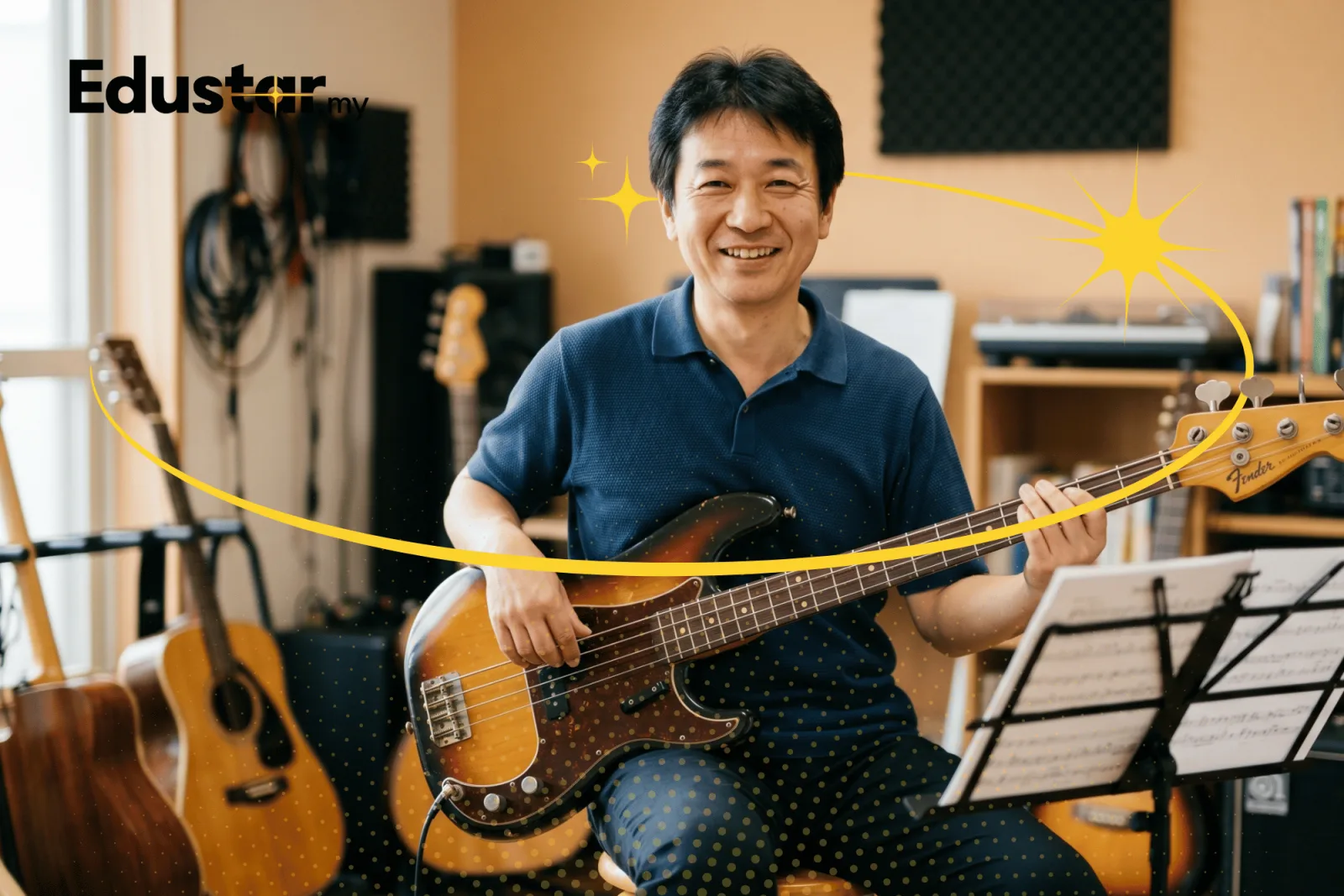
Bass guitar tuition in Malaysia is year-round 1-to-1 coaching that builds a rhythm-section player from the low end up. The right hand comes first: fingerstyle index-and-middle alternation (the James Jamerson Motown and Carol Kaye West Coast standard), plectrum attack for rock, punk and pop-rock, and slap-and-pop for the Larry Graham, Marcus Miller and Flea funk vocabulary — while the fretting hand learns as much about muting the strings that must stay silent as about pressing the ones that ring. On top of technique sits note choice: chord tones over root-and-fifth, arpeggio shapes and the major scale and its modes mapped across the neck, walking-bass construction over ii-V-I changes, and above all the timing discipline that locks the bass to the kick drum instead of floating around it. The applied layer aims at a real destination — Rockschool RSL Bass Guitar Debut + Grade 1-8 + DipRSL (Technical Exercises + 3 Performance Pieces + Technical Studies + Supporting Tests with sight-reading, improvisation, quick-study and ear test + General Musicianship Questions), Trinity College London Rock & Pop Bass Initial + Grade 1-8 (3 Songs from the Trinity selection + Session skills + Technical focus, plus optional Music knowledge — Grade 6+ carries UCAS tariff points for UK / Commonwealth university entry), or non-graded tracks for NECF Malaysia worship teams (DUMC Damansara Utama Methodist Church, FGA Subang First Assembly of God, City Harvest KL, Calvary Church KL, SIB KL Sidang Injil Borneo, Acts Church PJ) and MSSM marching band school concert-band rhythm sections. One decision sets the gear permanently: 4-string (E-A-D-G standard tuning, 34" scale length) is the universal default; 5-string (low B-E-A-D-G) reaches the low-D and low-C that modern worship, gospel and metal demand without down-tuning; fretless strips out the fret reference and lives in the Pino Palladino and Jaco Pastorius R&B / jazz lineage. Yamaha Music (Malaysia) Sdn Bhd stocks the Yamaha TRBX174 (entry RM 1,200-1,500), TRBX304 (intermediate RM 1,800-2,400) and TRBX604FM (senior RM 3,500-4,500) plus the BB series at Mid Valley, 1 Utama, Sunway Pyramid, The Curve, Sutera Mall Johor Bahru and Penang Gurney Plaza; Bentley Music KLCC, Penang Music Centre and Music Bliss SS2 PJ carry Fender Jazz Bass + Precision Bass, the Squier Affinity entry tier, Ibanez SR series, Sterling SUB Ray4, MTD Kingston and Schecter Stiletto. ASWARA (Akademi Seni Budaya & Warisan Kebangsaan, Jalan Tun Ismail KL, under MOTAC) and UiTM Faculty of Music (Shah Alam) both accept electric bass as a principal study at Diploma and Degree level. Every Edustar student gets a single bass coach calibrated to instrument choice (4 vs 5-string, fretted vs fretless), grade board and real use-case — worship rotation, band rhythm section, Rockschool diploma or ASWARA prep.
- 01Three right-hand attacks get drilled side by side from early on: fingerstyle (index-and-middle alternation, the James Jamerson and Carol Kaye foundation), plectrum / pick (rock, pop-rock and punk), and slap / thumb-pop (the Larry Graham, Marcus Miller, Flea and Victor Wooten funk vocabulary)
- 02Rockschool RSL Bass Guitar climbs Debut + Grade 1-8 to the DipRSL diploma: Technical Exercises + 3 Performance Pieces + Technical Studies + Supporting Tests (sight-reading + improvisation + quick-study + ear test) + GMQ, with UCAS tariff at Grade 6 = 8 pts, Grade 7 = 16, Grade 8 = 30
- 03Trinity Rock & Pop Bass runs Initial + Grade 1-8 on the current 2024-2027 cycle — 3 Songs (Trinity selection + Session skills + Technical focus) plus Session skills and optional Music knowledge; its Grade 6-8 UCAS tariff matches Rockschool
- 04ABRSM Bass Guitar (Electric) Grade 1-8 is the more classical-conservatory-flavoured route; ABRSM Malaysia centres sit in KL, PJ, Penang, Ipoh, JB, Kuching and KK
- 05String count is the first fork: 4-string (E-A-D-G, 34" scale) is the universal default; 5-string (low B-E-A-D-G) reaches low-D and low-C without down-tuning, essential for modern worship, gospel, metal and R&B; 6-string (B-E-A-D-G-C) is jazz-fusion territory only
- 06Frets or none: a fretless strips away the fret reference and demands exact intonation — the Pino Palladino and Jaco Pastorius lineage — so it is never a first bass; start fretted and add fretless after Grade 3-4
- 07Yamaha Music Malaysia stocks the TRBX174 (entry RM 1,200-1,500), TRBX304 (intermediate RM 1,800-2,400), TRBX604FM (senior RM 3,500-4,500) and BB series at Mid Valley, 1 Utama, Sunway Pyramid, The Curve, Sutera Mall JB and Penang Gurney Plaza
- 08Bentley Music KLCC, Penang Music Centre and Music Bliss SS2 PJ carry Fender Jazz + Precision, the Squier Affinity entry tier, the Ibanez SR series, Sterling SUB Ray4, MTD Kingston and Schecter Stiletto
- 09Worship-team bass is the biggest hobbyist pull in MY: NECF churches (DUMC, FGA Subang, City Harvest KL, Calvary Church KL, SIB KL, Acts Church PJ) want chord-chart reading, the Nashville Number System, click-track and Ableton stem playback, and an in-ear monitor mix
- 10Reckon on about a grade a year: Grade 1-3 run 6-12 months each at 30-45 min daily, Grade 4-5 around 12 months each at 45-60 min daily, Grade 6-8 some 12-18 months each at 60-90 min daily plus steady band or worship-rotation playing
- 11Bass touchstones worth studying — locally the Wings rhythm section (rock), the Search bass canon (Razak Rahman era) and AC Mizal's rhythm section; internationally James Jamerson (Motown fingerstyle), Jaco Pastorius (fretless), Marcus Miller (slap fusion), Victor Wooten (thumb-pop), Flea (slap rock) and Pino Palladino (fretless R&B)
- 12Tertiary doors open at ASWARA (Diploma + Degree in Muzik, MOTAC) and UiTM Faculty of Music (Shah Alam Diploma + B.Mus), both accepting bass as principal study; KLPAC, DPAC and penangpac host bass masterclasses
- 13Every learner gets one bass coach tuned to 4 vs 5-string, fretted vs fretless, grade board and real use-case — in person across Klang Valley, Penang and Johor, online nationwide via Zoom with tab and Ableton stem share
Who bass guitar tuition in Malaysia is for
We fit the coach and curriculum to where the player actually stands: hobbyist starters of any age, school-band rhythm-section and marching band players, worship-team volunteers, and Rockschool / Trinity grade aspirants.
Hobbyist starters (kids 8+ through adults)
A first-time bass player with no exam on the horizon — they just want to lock a rhythm section and play the songs they love. It might be a Year 4-6 kid whose parent brought home a Squier Mini-P or Yamaha TRBX174, a teenager who fell for the instrument watching Wings or Search rhythm-section clips, or an adult finding bass at 30-50 as a release valve or a way into a jam. The coaching leans on the right hand — fingerstyle and plectrum — plus root-fifth-octave patterns, metronome discipline, a little theory and ear, and the four-chord-wonder repertoire (Tanya Sama Itu Hud Hud, Stand By Me, Wonderwall, and three or four worship standards). Six months in, the aim is 8-10 complete songs locked to a click and a clear-eyed choice: commit to a grade ladder, or settle happily at the hobby ceiling.
- Bought a bass months ago, still playing only roots — doesn't know what to learn next
- YouTube tutorials are random — no clear order, no progress signal
- Right hand is tense and uneven — doesn't know how to fix it without a coach watching
- Doesn't know whether to stay 4-string or move to 5-string for the music they actually like
School-band rhythm section + MSSM marching band concert-band bass (Form 1-5)
This student already holds the bass chair in the school band rhythm section — typically Form 1-5 at an SK, SJK, SMK, SBP or private school — or plays concert-band electric bass in MSSM Pancaragam competition. The work centres on rhythm-section discipline: locking to the drums, the kick-and-bass-note alignment above all, reading bass-clef notation at sight (concert-band charts use bass clef and tab is rare in the MSSM world), a 16th-note and ghost-note funk vocabulary, and walking-bass construction for jazz-band electives — with the Rockschool RSL Bass Grade 2-5 syllabus running alongside as exam validation. The target is a dependable section player at school plus a first grade certificate by Form 3.
- Plays in school band but never locked tightly to the drummer's kick — timing drifts
- Reads tab but cannot read standard bass-clef notation — limits him in concert-band charts
- Doesn't know whether to pursue Rockschool, Trinity, or ABRSM for grade validation
- MSSM marching band pieces sit at intermediate difficulty but no structured private lessons at school
Worship-team rhythm-section volunteers (KL + PJ church bassists, ages 14-50+)
A teen or adult who plays casually and has been asked onto — or wants to earn a spot on — the worship-team rotation at a NECF Malaysia church (DUMC, FGA Subang, City Harvest KL, Calvary Church KL, SIB KL, Acts Church PJ) or any Hillsong / Bethel / Planetshakers-styled contemporary service. The coaching covers the instrument call (most modern worship leans 5-string for the low-D that transposed keys demand), reading a Nashville Number System chart at sight, click discipline across 60-130 BPM, running an Ableton Live or Multitracks.com stem rig, routing an in-ear monitor mix, and the dynamic language of a contemporary set — verse soft, chorus full, bridge pulled back, modulation lifted.
- Plays roots fine but freezes when the worship leader transposes mid-song
- Never read a Nashville Number System chart — only knows chord-name format
- Stem playback rig + in-ear mix is a new world — doesn't know which output goes where
- Wants to graduate from playing only roots to genuine rhythm-section walking + fills in worship
Rockschool / Trinity grade aspirants + DipRSL track (Form 1-5 + adult improvers)
Past the beginner stage, one to three years in, this player now wants the structure of a graded path — Rockschool RSL Bass Guitar Grades 2-8 plus DipRSL, or Trinity Rock & Pop Bass Grades 2-8 with the UCAS tariff from Grade 6. The coaching covers the whole syllabus (Technical Exercises + Performance Pieces + Technical Studies + Supporting Tests for Rockschool; 3 Songs + Session skills + Music knowledge for Trinity), mock-exam discipline, exam-day logistics at MY centres, and — for the strongest — a DipRSL recital and written commentary. It suits committed teens aiming at UK or Commonwealth university entry and adult improvers who want an external read on where their playing actually stands.
- Plays well but no objective verification of skill level — wants the graded record
- Confused between Rockschool and Trinity — which pathway suits them better
- Sight-reading + ear test components feel underdeveloped vs the performance pieces
- Stuck around Grade 3-4 ceiling — slap technique + walking bass + reading all need lift to break through
What bass guitar tuition covers
Three modules across the bass journey — foundations (fingerstyle + plectrum + 4-chord root patterns + basic theory), intermediate (slap + pop + walking bass + Rockschool Grade 3-5), advanced (jazz walking + funk + odd-time + Rockschool / Trinity Grade 6-8 + DipRSL).
Foundations — fingerstyle, plectrum, 4-chord root patterns, basic theory (kids 8+, teens, first-time adults)
Foundations turns a curious beginner into someone who can hold down a root-and-fifth and stay locked to a click. The 4-string E-A-D-G neck gets mapped, fingerstyle alternation (index + middle) and plectrum attack are learned side by side, and the left hand starts muting the strings it is not playing — the habit that separates a clean bass tone from a buzzing one. The four-chord workhorse progression (C-G-Am-F or G-D-Em-C) opens hundreds of MY pop, Malay rock and worship songs at root + fifth + octave. It suits primary-school kids on a short-scale Squier Mini-P or Ibanez miniBass, teens on a Yamaha TRBX174, and adult beginners alike. By the end the student plays 8-10 complete songs in time with a metronome and is ready for Rockschool Debut or Grade 1, or Trinity Initial.
Instrument choice (4-string vs 5-string for first bass — 4-string default unless student already knows they need low-B; fretted vs fretless decision — start fretted always; short-scale 30" vs medium 32" vs standard 34" scale by player age and hand size; Squier Affinity Jazz / Yamaha TRBX174 / Ibanez SR300 / Sterling SUB Ray4 entry-tier comparison at RM 1,200-2,000); right-hand fingerstyle technique (index + middle alternation, planting on next-lower string, even-volume control, muting with palm and floating thumb); plectrum technique (down-stroke vs alternate picking, pick angle, palm-mute discipline for rock and punk feel); left-hand position (one-finger-per-fret span, thumb position behind neck, no death-grip pressure); reading TAB + standard notation (bass clef from open E2 to G4, ledger lines, rhythm notation 1/4 / 1/8 / 1/16); root + fifth + octave + flat-seven pattern (the rock + pop + country foundation); 4-chord root-only progressions (C-G-Am-F, G-D-Em-C — the foundation of hundreds of worship and Malay pop songs); first complete songs (Tanya Sama Itu Hud Hud bass line, Isabella Search bass intro, Stand By Me walking root-fifth, Wonderwall Oasis, plus 3-4 NECF-worship-standard chord charts in G or D); metronome discipline from day one (60-90 BPM quarter-note locked); first major and minor pentatonic scales (one box shape each); Rockschool Bass Debut + Trinity Bass Initial syllabus walkthrough; instrument care basics (string change, intonation check, action adjustment intro).
Intermediate — slap + pop, walking bass, ghost notes, Rockschool Grade 3-5 (school-age + committed adult intermediates)
Intermediate is where a root player becomes a groove player. Slap and pop (thumb plus index pluck) bring the funk, gospel and modern-worship vocabulary; walking bass over ii-V-I changes opens jazz and bossa; ghost notes and dead notes tighten the pocket so the line breathes with the drummer instead of sitting on top of it. The Rockschool RSL Grade 3-5 or Trinity Rock & Pop Bass Grade 3-5 syllabus drives the weekly drilling. It fits school-age students (Form 1-5, SPM-going), worship-team volunteers stepping into rotation, and committed adult intermediates.
Slap technique (thumb on E + A strings, pop with index on D + G strings; slap-thumb angle parallel to fretboard; left-hand muting essential to clean slap tone); right-hand finger-style at speed (60 to 130 BPM eighth notes); walking-bass construction (root → approach note → chord tone → chromatic passing); ii-V-I jazz harmony (Dorian on the ii, Mixolydian on the V, Ionian on the I); blues progression walking bass (12-bar blues in F + Bb + E); ghost notes + dead notes (left-hand muted percussive hits — the Larry Graham + Bernard Edwards funk anchor); octave + tenths walking patterns (the Motown James Jamerson canon); arpeggio extension (major 7, minor 7, dominant 7, diminished — all four voicings across the neck); minor pentatonic + blues scale (5 box shapes); major scale + 7 modes (positional fluency, theory made playable); Rockschool RSL Bass Grade 3-5 Performance Pieces + Technical Exercises + Technical Studies (improvisation + quick-study + sight-reading + ear test); Trinity Rock & Pop Bass Grade 3-5 set pieces + Session skills + technical focus; first transcription discipline (transcribe one Motown Jamerson bass line + one Marcus Miller slap line + one Flea rock line per quarter); intro to Ableton Live + Logic for stem playback + practice; recording bass lines on a phone for self-review; first worship-team rotation entry (Nashville Number System chord-chart reading at sight, click track at 60-120 BPM, key transposition under pressure).
Advanced — jazz walking, funk, odd time, Rockschool / Trinity Grade 6-8 + DipRSL
Advanced separates the Grade 8 certificate from a working rhythm-section musician. Coaches steer the syllabus toward the chosen destination — Rockschool RSL Bass Grade 6-8 + the DipRSL diploma, Trinity Bass Grade 6-8 (UCAS tariff for UK / Commonwealth entry), or the non-graded ASWARA + UiTM tertiary track. Walking bass at tempo, double-thumb and triplet slap in the Victor Wooten lineage, Latin and Brazilian feels, odd time signatures, and the fretless voice are where note choice and time turn into a craft rather than an exercise.
Full CAGED-style modal harmony on bass (Dorian for funk, Mixolydian for blues, Lydian for film + modern worship); advanced walking bass (Ray Brown + Ron Carter transcription, chromatic approach + enclosure + bebop scale); two-feel vs four-feel jazz time (latin bossa two-feel, swing four-feel transitions); modal interchange + tritone substitution applied to bass-line composition; advanced slap (double-thumb up-down stroke + triplet groupings — Victor Wooten technique); tapping (right-hand tap + left-hand hammer — Jaco Donna Lee + Stu Hamm canon); chord-tone soloing + walking-and-soloing simultaneously (the Marcus Miller signature); fretless playing (intonation calibration, mwah tone via flatwound strings, Pino Palladino + Jaco vibrato vocabulary); Brazilian bossa nova + samba bass patterns (Sergio Mendes + Carlinhos Brown lineage); Afro-Cuban tumbao + montuno bass patterns (mambo, songo, cha-cha); odd time signatures (5/4 Take Five, 7/8 progressive rock, 5/8 + 7/4 math rock + djent); Rockschool RSL Bass Grade 6-8 Performance Pieces (typical advanced selection: Tower of Power-style funk, Weather Report fusion, Jaco fretless transcription studies, Stevie Wonder Songs in the Key of Life-era grooves); DipRSL (Diploma in Music Performance) prep — 35-40 minute recital programme + written commentary + viva + supporting tests at diploma level; Trinity Bass Grade 6-8 Songs + advanced session skills (playback + improvising over unfamiliar charts); transcription discipline at advanced level (transcribe 2-3 minutes of a master bassist per month — James Jamerson Motown era, Jaco Word of Mouth, Marcus Miller Tutu, Victor Wooten Vu Du Mama, Flea Blood Sugar Sex Magik, Pino Palladino John Mayer Trio era); session-bass recording discipline (DAW basics in Pro Tools / Logic / Reaper, DI vs amp-mic'd tone, compression + EQ for bass tracking); MY tertiary pathway briefing — ASWARA Diploma + Degree in Muzik + UiTM Faculty of Music B.Mus audition repertoire, Berklee Online + Berklee Boston scholarship audition prep, MI Hollywood Bass programme alternative; full live-band performance discipline (gig load-in to load-out, on-stage IEM mix calls, charts marking).
From first call to first bass lesson
How starting bass guitar tuition with Edustar works — instrument choice first, syllabus matching second, weekly drilling third.
- 1
Free bass consultation — goals, gear, grade board
Tell us the player's age and where the right hand is right now — never touched a bass, can hold a root, has a year or two under the fingers, or already deep in a grade syllabus. We map out the instrument situation (own a bass yet, which model, 4-string or 5-string, fretted or fretless), the real target (hobby groove, Rockschool RSL or Trinity grade, ABRSM Bass Electric, the worship rotation at a named NECF church, school rhythm section, MSSM Pancaragam, or an ASWARA / UiTM audition), and how many hours a week the practice amp will actually be on. You leave the call knowing which syllabus board and instrument setup fit, and an honest read on how far that gets you in the time you have.
~15 min - 2
Instrument check — 4 or 5-string, amp, setup
No bass yet? The coach names exact starters — Squier Affinity Jazz Bass, Yamaha TRBX174, Ibanez SR300 or Sterling SUB Ray4 at the entry tier (RM 1,200-2,000) — paired with a first practice amp (Hartke HD15, Fender Rumble 25, Yamaha BBT215), and points you at where they actually sit on the shelf: Yamaha Music Malaysia at Mid Valley / 1 Utama / Sunway Pyramid / Sutera Mall JB / Penang Gurney, plus Bentley Music KLCC, Penang Music Centre and Music Bliss SS2. The 4-string-versus-5-string call gets made here, against the music the student wants to play. Already own a bass? The coach checks the setup that ruins more beginners than bad technique does — action height, intonation, string gauge, pickup balance — and dials it in before lesson one.
Within Day 0-1 - 3
Coach matching — groove specialism + temperament
Bass coaching splits by world, so the coach is chosen to fit the player's. Grade-track students draw a coach who has sat Rockschool RSL Grade 8 + DipRSL or Trinity Grade 8 themselves; worship volunteers draw an active rotational bassist from a major KL / PJ NECF church (DUMC, FGA Subang, City Harvest KL, Calvary, SIB KL) who lives in the Nashville Number System; ASWARA / UiTM hopefuls draw a walking-bass and jazz-fusion specialist; Pancaragam concert-band players draw someone who reads bass clef on sight. Lessons run in person across Klang Valley, Penang and Johor, or online nationwide over Zoom with a bass-cam, tab sharing (Songsterr, Ultimate-Guitar files) and Ableton stem screen-share.
1-3 days - 4
First lesson — hands, tone, one groove that sticks
The coach takes a baseline first — right-hand fingerstyle alternation, fretting-hand position, how clean the muting is, and the tempo ceiling against a click. A raw beginner spends the opening three weeks on index-middle alternation, root-fifth-octave on the E and A strings, and one whole song they already know (a three-chord worship tune or a Malay pop number). An intermediate player gets a technique reset on the two or three faults the diagnostic flagged, then the first set piece from the chosen grade. Either way the student walks away with a groove locked to the metronome that they can play for the family that evening.
Lesson 1 - 5
Weekly sessions — technique, grooves, ear
Weekly sessions run 45-60 minutes (30-45 for younger kids). Each one rotates through three jobs: the hands — alternation, fretting-hand drills, slap mechanics, and a metronome ramp from 60 BPM up toward the current ceiling; the groove — the current grade set piece or this week's worship-rotation chart; and the ear and the page — chord-symbol reading, the Nashville Number System for worship players, bass-clef reading for Pancaragam players, interval recognition for everyone. Homework between lessons is concrete: 30-45 minutes a day, usually one groove or piece, one technical exercise, and five to ten minutes locked to the click.
Ongoing — weekly - 6
Exam, worship rotation or audition run-up
Eight to twelve weeks out from a Rockschool RSL, Trinity or ABRSM bass exam, lessons turn into dress rehearsals — set pieces under exam conditions, technical exercises at exam tempo, and the supporting tests (ear test, sight-reading) that beginners always leave too late. Worship-bound students instead rehearse a full service: charts at sight, instant transposition when the worship leader shifts key, click and stem playback running live. Pancaragam and school-band players get ensemble-section coaching ahead of MSSD / MSSN / MSSM Kebangsaan competition, and ASWARA / UiTM candidates build the full recital programme plus viva answers.
Final 8-12 weeks pre-event - 7
Debrief + the next cycle
Once the exam is done — results land four to six weeks later from Rockschool, Trinity or ABRSM — the coach and student sit with the recording of the exam-day take and decide what the next cycle holds: fresh repertoire, the next rung of technical exercises, another theory layer. Players leaving the grade ladder for the stage pick up DAW basics here instead — bass tracking in Logic, Pro Tools or Ableton, DI versus a mic'd amp, compression and EQ for a recorded bass tone — plus a first run at writing original lines. Each year the route bends to the player: another grade, or a turn toward worship, a band, session work or songwriting.
2 weeks post-exam
Things parents ask us first
4-string vs 5-string — the first instrument decision
The single biggest first-instrument decision for a new MY bass student is 4-string vs 5-string. The 4-string (E-A-D-G standard tuning, 34" scale length) is the universal default — every Rockschool RSL and Trinity grade syllabus is built around it, every classic rhythm-section repertoire (Motown, classic rock, reggae, punk, pop) sits on it, and every entry-tier bass model (Squier Affinity Jazz, Yamaha TRBX174, Ibanez SR300, Sterling SUB Ray4 at RM 1,200-2,000) is a 4-string by default. The 5-string (low B-E-A-D-G) adds a low B string that unlocks low-D and low-C without ever down-tuning. The 5-string is essential if the student's real target is modern worship music at NECF churches (DUMC, FGA Subang, City Harvest KL, Calvary, SIB KL — Hillsong / Bethel / Planetshakers-influenced services where worship leaders sing in keys requiring low-D), gospel, modern R&B or metal. Yamaha TRBX305 + TRBX605FM are MY 5-string options (RM 2,200-4,500). Practical Edustar rule: under-12 kids + classic rock / punk / pop target → 4-string. Worship-team or gospel target → consider 5-string from the start, or start 4-string and add a 5-string after Grade 3. The 6-string (B-E-A-D-G-C) is jazz-fusion territory only and not recommended as a first or second instrument.
Fretted vs fretless — start fretted always, fretless after Grade 3-4
Fretless bass has no fret wires — the strings ring against a smooth fretboard, the player controls pitch entirely by left-hand finger position. The fretless lineage is iconic: Jaco Pastorius (Donna Lee, Teen Town, Weather Report), Pino Palladino (Paul Young, D'Angelo, John Mayer Trio), Mick Karn (Japan), Tony Franklin (The Firm). The mwah tone — that vocal, sustained, vibrato-rich timbre fretless produces especially with flatwound strings — is genuinely beautiful and irreplaceable. But: intonation on a fretless is hard. Without fret wires, the student must know exactly where each pitch lives on the fretboard, and small finger-position errors produce audibly out-of-tune notes that no studio EQ can fix. Standard advice: start on a fretted 4-string, drill ear training and intonation discipline for the first 2-3 years, then add a fretless after Rockschool Grade 3 or Trinity Grade 3. Adding a fretless earlier produces frustration and entrenches sloppy intonation habits. Few entry-tier fretless models exist in MY (Squier Vintage Modified Fretless Jazz at RM 2,200-2,800, Cort B4Plus FL at RM 2,800-3,500); plan to special-order from Bentley Music KLCC or Music Bliss SS2 if the time comes.
Worship-team rhythm-section bass — the largest MY hobbyist demand segment
The single largest hobbyist-bass-coaching demand in Klang Valley right now is worship-team volunteers from NECF Malaysia member churches (DUMC Damansara Utama Methodist Church, FGA Subang First Assembly of God, City Harvest KL, Calvary Church KL, SIB KL Sidang Injil Borneo, Acts Church PJ) plus the Hillsong / Bethel / Planetshakers-influenced contemporary services across KL + PJ. Worship bass has its own non-graded curriculum that does not require Rockschool or Trinity grades. The student must master: chord-chart reading at sight (CCLI lyric-chart format), Nashville Number System fluency (1-5-6-4 progressions in any key — the worship leader changes keys between songs and the bass must transpose instantly), root-octave-fifth-flat-seven walking patterns for ballad verses, eighth-note pulse for mid-tempo choruses, click-track discipline (60-130 BPM range, Ableton click on bar 1 + 3), Multitracks.com or Ableton stem playback rig operation (the bass player often runs the click + stems for the band), in-ear monitor mix (no stage monitors at most modern services), and the dynamics language of contemporary worship (verse low, chorus full, bridge pull-back, modulation lift). None of this is on a Rockschool syllabus. An Edustar worship-track bass coach builds this skill set in 4-8 months — typically faster than a grade track because the goal is congregation-ready, not exam-ready. Grade exams remain possible in parallel.
Rockschool RSL vs Trinity Rock & Pop Bass — pick by pathway, not by reputation
Both Rockschool RSL Bass Guitar (Debut + Grade 1-8 + DipRSL) and Trinity College London Rock & Pop Bass (Initial + Grade 1-8, current 2024-2027 syllabus cycle) are internationally recognised contemporary bass-grade qualifications, both run regular exam sessions in MY through authorised centres. The substantive difference: Rockschool requires 3 Performance Pieces + Technical Exercises + Technical Studies + Supporting Tests (sight-reading + improvisation + quick-study + ear test) + General Musicianship Questions — heavier on technical and theory components, no Grade 5 Theory prerequisite (unlike ABRSM classical). Trinity Rock & Pop Bass requires 3 Songs (Trinity selection + Session skills + Technical focus) + Session skills + optional Music knowledge — slightly more performance-weighted. Both Grade 6+ tiers carry UCAS tariff points (Grade 6 = 8 UCAS points, Grade 7 = 16, Grade 8 = 30) which materially help UK / Commonwealth university applications. Practical rule: Trinity if the student wants slightly more song-driven exam experience and the UCAS tariff at G6-8. Rockschool if the deeper technical + theory syllabus suits the student or DipRSL diploma is the eventual target. Pick one in Grade 2-3 and stay with it through Grade 8 — switching boards mid-pathway wastes 6-12 months of syllabus alignment. ABRSM Bass Guitar (Electric) Grade 1-8 is a third option, more classical-conservatory in flavour, available at ABRSM Malaysia centres in KL, PJ, Penang, Ipoh, JB, Kuching, KK.
Electric bass guitar vs upright / double bass — these are different instruments
Malaysian families sometimes treat 'bass lessons' as a single thing — it is not. The electric bass guitar (what this page covers) is a fretted or fretless instrument with 4, 5 or 6 strings tuned E-A-D-G (low to high), played horizontally with fingerstyle, plectrum or slap technique through an amplifier, and is the rhythm-section instrument in rock, pop, funk, jazz fusion, gospel, worship, metal and most contemporary genres. The upright / double bass (kontrabas) is the orchestral and traditional jazz instrument — much larger (full-size body ~180 cm tall), tuned the same E-A-D-G but played either with a bow (arco) for classical orchestra repertoire or pizzicato fingerstyle for jazz, blues and rockabilly. Upright bass technique is completely different (left-hand thumb position above the neck shoulder, half-position to thumb position fingering system, no frets, bow grip for arco) and lives in the ABRSM Double Bass Grade 1-8 / Trinity Double Bass / national orchestra audition track — MPO (Malaysian Philharmonic Orchestra) + State orchestra repertoire. Edustar coaches generally specialise in one or the other. Be specific about which one you want during the free consultation — the curriculum, instrument, repertoire and teacher are different. This page covers electric bass guitar specifically.
What bass guitar tuition with Edustar covers
A frank scope: structured year-round Rockschool / Trinity / ABRSM-aligned coaching plus worship-team and band-rhythm-section tracks, with no grade pass promised.
Age 8 – adult
Ages coached — from a first short-scale bass to DipRSL and ASWARA level
Rockschool + Trinity + ABRSM
Bass grade boards on offer (RSL Bass Debut-8 + DipRSL, Trinity Rock & Pop Bass Initial-8, ABRSM Bass Electric 1-8)
4 + 5-string, fretted + fretless
Bass setups taught, matched to the music
Nationwide
Studio or online over Zoom, with tab and Ableton stem share
Where bass guitar tuition runs along the Malaysian pathway
From first-bass exposure to the DipRSL / ASWARA / UiTM tertiary track: a multi-year journey coordinated under Rockschool RSL, Trinity Rock & Pop, ABRSM, NECF worship-team rotations, and MSSM marching band concert-band.
- 01
Age 8-10 (first exposure)
The first bass usually has a short 30" scale — a Squier Mini-P, Ibanez miniBass or Cort Action Junior, or a junior-friendly Yamaha TRBX174 strung with a lighter gauge so small hands can fret it. Everything early is physical: how to hold the instrument, index-middle alternation in the right hand, one-finger-per-fret on the left, root-only along to simple songs, and a click held at 60-80 BPM. The Yamaha Music School Junior Music Course (JMC) often pairs bass with general musicianship and ear training at this age. No grade pressure yet — the whole point is to wire in the playing habit and the instinct to sit in a rhythm section.
- 02
Year 4-6 (primary, first kit + Rockschool Debut / Trinity Initial)
Hands have grown enough for a full 34" scale (or 32" medium if they are borderline), and the family commits to a real first bass. The common MY entry buy is a Squier Affinity Jazz Bass with a small practice amp — a Hartke HD15 or Fender Rumble 25 — at RM 1,400-2,000 all in, or a Yamaha TRBX174-and-amp combo at RM 1,500-1,800. The first exam target appears: Rockschool RSL Bass Debut or Grade 1, or Trinity Rock & Pop Bass Initial or Grade 1, usually attempted at the end of Year 5 or Year 6, with tab and first standard-notation reading running in parallel. A few private and private-feeder primaries run informal rhythm-section sessions where the bass chair first opens up.
- 03
Form 1-3 (lower secondary, Rockschool / Trinity Grade 3-5)
This is where the syllabus gets its teeth — Rockschool RSL Bass Grade 2-3-4-5 or Trinity Rock & Pop Bass Grade 2-3-4-5 in sequence. Slap and pop enter, walking bass over ii-V-I cracks open the jazz door, 16th-note and ghost-note funk tighten the groove, and church-active students step into their first worship-team rotation. MSSM Pancaragam concert-band recruitment tends to land around Form 1-2 for marching and concert players, and a school jazz-band elective sometimes surfaces by Form 3.
- 04
Form 4-5 (SPM years, Grade 5-7 + UCAS-relevant Trinity track)
Grade 5-6-7 on Rockschool or Trinity, and from Grade 6 the UCAS tariff (G6 = 8, G7 = 16, G8 = 30) starts pulling weight on UK and Commonwealth applications. The SPM year usually squeezes practice down to 20-30 minutes a day for six months; the disciplined move is to freeze new repertoire, keep technical exercises and metronome work ticking over, then pick the syllabus back up afterwards. This is also when serious transcription begins — a Jamerson, Marcus Miller or Flea line a quarter — and when ASWARA or UiTM Faculty of Music audition prep can start if a conservatory is the destination.
- 05
Pre-U / Adult improver / DipRSL Diploma track
The diploma window: Rockschool DipRSL or a Trinity Bass Grade 8 plus diploma-track build — a 35-40 minute recital programme, viva, written commentary and diploma-level supporting tests. Serious popular-music and fusion players prep the ASWARA Diploma + Degree in Muzik audition on electric bass principal, or the UiTM Faculty of Music Diploma + Bachelor of Music (Composition / Performance / Music Education) at the same level. Adults outside formal schooling point the same skills elsewhere — a full worship rotation across several churches, the cover / wedding / event circuit, and original-band recording, learning DAW basics (Pro Tools, Logic, Reaper, Ableton) along the way.
- 06
Adult session / cover / worship / professional ceiling
A lifelong adult chair usually blends three of: a worship rotation across NECF churches; the cover, wedding and corporate-event circuit; original-band recording and gigging; and the MY session-bass market — KLPAC, DPAC and penangpac musicals, the Akademi Fantasia and Star Search Asia house bands, Astro production stages, and jazz nights at No Black Tie, Merdekarya and KLPAC Pentas 2. Some keep picking off Rockschool Grade 6-8 purely as a personal benchmark. The international door stays open too — Berklee Online and Berklee Boston scholarship auditions, the MI Hollywood Bass programme, ICMP London.
Frequently Asked Questions
What Malaysian parents, students and adult bass learners ask us most.
Start Bass Guitar tuition with Edustar
A free needs assessment first, then a bass coach matched within 1-3 days. Rockschool RSL, Trinity Rock & Pop, ABRSM Bass Electric, worship-team rhythm section and band tracks, nationwide in-person or online.
- Free needs assessment + first-bass recommendation (4 vs 5-string, fretted vs fretless)
- Coach matched by specialism (Rockschool / Trinity / worship / band) + temperament
- Sequenced curriculum: fingerstyle + plectrum → slap + walking → grade pieces → diploma
- Rockschool RSL + Trinity Rock & Pop + ABRSM Bass Electric exam prep
- Worship-team Nashville Number System + click + Ableton stem playback supported
- Home or online — nationwide
Edustar — Malaysian private tuition, KPM-aligned tutors.