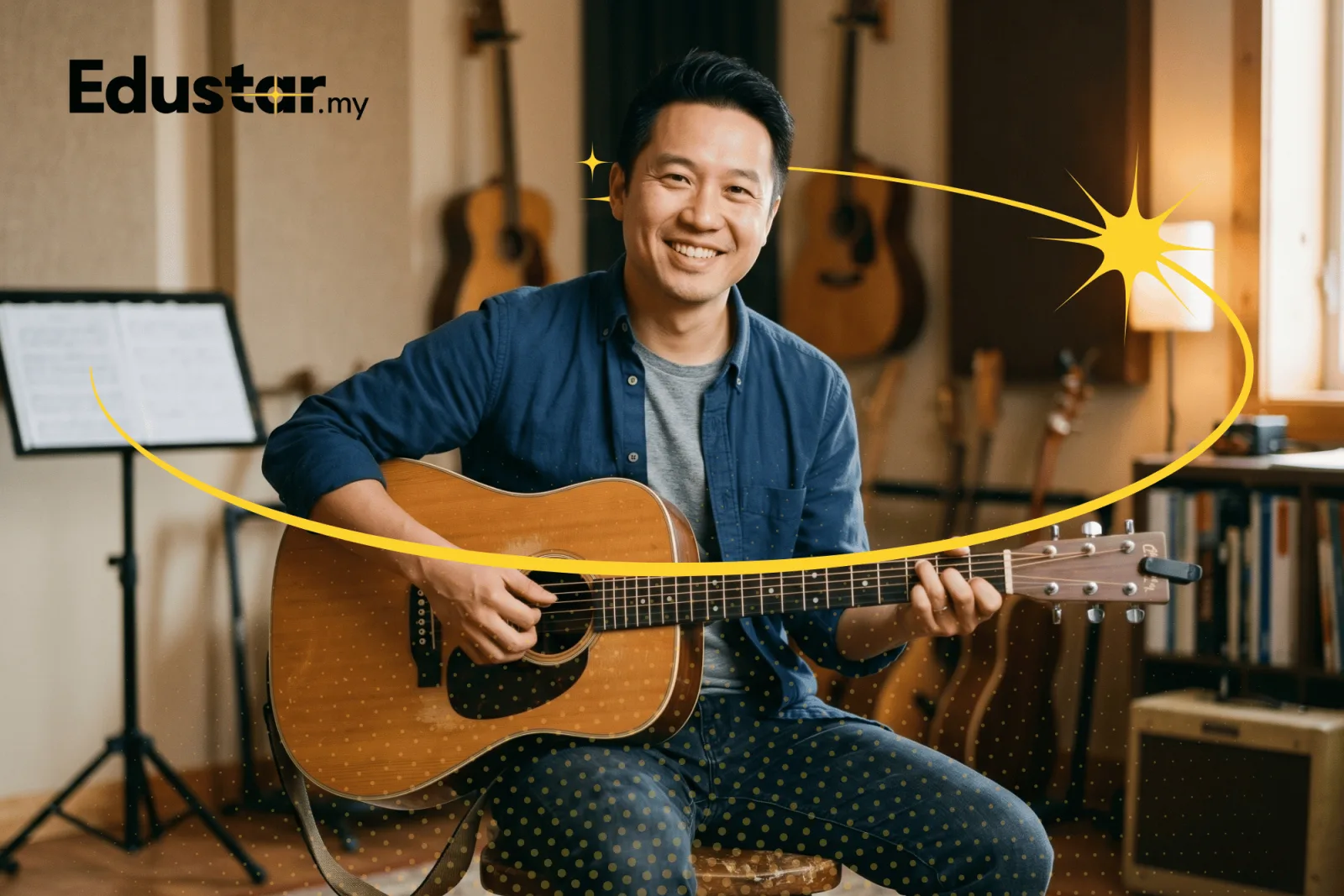
Music Mastery Course in Malaysia
A Music Mastery course is cross-instrument coaching beyond a single grade exam: combining ABRSM or Trinity Music Theory Grade 1-8, composition + arrangement, and DAW production (Logic Pro X, Ableton Live, FL Studio). The track unlocks ABRSM Grade 6-8 Practical via the Grade 5 Theory gate and prepares UCSI Institute of Music, ASWARA, UPSI, UM and UiTM degree auditions.
What is Music Mastery Course?

A Music Mastery course in Malaysia is structured year-round 1-to-1 coaching for students who have moved past single-instrument grade exams and now need the cross-instrument musicianship that serious composition, arrangement, and tertiary music degrees demand. It runs three parallel strands. The Theory strand covers ABRSM Music Theory Grade 1 → Grade 8 (or Trinity College London Theory Grade 1-8 as an alternative): the universal **ABRSM Grade 5 Theory paper is a hard prerequisite** for anyone wanting to enter Grade 6, 7 or 8 Practical on any ABRSM instrument or voice. The Composition + Arrangement strand teaches chord progressions, voice leading, four-part harmony in the Bach chorale style, melody writing with modulation, species counterpoint, score-reading and harmonic analysis, the material that ABRSM Grade 6-8 Theory papers and tertiary audition portfolios actually assess. The Production strand teaches a contemporary DAW (Digital Audio Workstation): typically Logic Pro X (Apple, RM 999 one-time, default at UCSI Institute of Music), Ableton Live (RM 599 Intro to RM 2,799 Suite, electronic + session-view workflow), FL Studio (RM 399 to RM 2,099, EDM / hip-hop / K-pop standard), or Pro Tools (subscription, studio recording standard), alongside MIDI sequencing, mixing fundamentals, and a commercial-track production workflow. Beyond Grade 8 + Diploma, the MY tertiary music pathway runs through UCSI Institute of Music (once ICOM, the International College of Music, Bachelor of Music Hons + Diploma in Music), ASWARA (the Akademi Seni Budaya dan Warisan Kebangsaan on Jalan Tun Ismail KL, under KPM, Diploma Muzik + Bachelor of Music with strong Malaysian traditional music integration), UPSI (Universiti Pendidikan Sultan Idris, Tanjong Malim, Ijazah Sarjana Muda Pendidikan Muzik for the KPM school music teacher track), UM Cultural Centre (Bachelor of Performing Arts Music, Performance / Composition / Musicology streams), and UiTM Faculty of Music (Shah Alam, Bachelor of Music + Diploma Muzik). Edustar lines up a tutor tuned to the student's existing instrument(s), exam-board choice (ABRSM vs Trinity Theory), DAW choice (Logic / Ableton / FL Studio), and tertiary target: single tutor for theory + composition, often paired with a separate production-focused tutor for the DAW strand. Performance venues: KLPAC (Kuala Lumpur Performing Arts Centre, Sentul West) and DFP (Dewan Filharmonik Petronas KLCC, home of the MPO Malaysian Philharmonic Orchestra and the MPYO Malaysian Philharmonic Youth Orchestra), frame the recital and showcase reference for serious students.
- 01Music Mastery is a cross-instrument course: it assumes the student already plays piano, guitar, violin, drums or sings at ABRSM / Trinity Grade 3+ and now needs the theory + composition + production stack around that instrument
- 02ABRSM Grade 5 Theory is a hard, universal prerequisite for entering Grade 6, 7 or 8 Practical on any ABRSM instrument: fail to clear it and the practical ladder stalls at Grade 5, regardless of how good the playing is
- 03Three exam-board options for theory: ABRSM Music Theory Grade 1-8 (most rigorous, gates ABRSM practical Grade 6+), Trinity College London Theory Grade 1-8 (no Grade 5 gate, more practical-application focus), or both
- 04ABRSM Grade 6-8 Theory covers figured bass realisation, four-part Bach-chorale-style harmony, melody writing with modulation, score-reading of orchestral and choral excerpts, the same material UCSI / ASWARA / UM Music degree auditions test
- 05DAW production stack: Logic Pro X (Apple macOS, RM 999 one-time, UCSI Institute of Music default), Ableton Live (RM 599 Intro to RM 2,799 Suite), FL Studio (RM 399 Fruity to RM 2,099 All Plugins, K-pop / EDM standard, lifetime free updates), Pro Tools (subscription RM 150-300/month, studio recording standard)
- 06MY tertiary music degree pathway: UCSI Institute of Music (Cheras, Bachelor of Music Hons in Classical / Contemporary / Production / Education), ASWARA (KL, Diploma Muzik + Bachelor of Music with Malaysian traditional music), UPSI (Perak, B.Ed Music for KPM school teacher track), UM Cultural Centre (Bachelor of Performing Arts Music), UiTM (Shah Alam, Bachelor of Music + Diploma Muzik)
- 07Audition baseline for all five MY universities: Grade 8 ABRSM / Trinity Practical (any instrument) + Grade 5 Theory minimum + audition piece + theory diagnostic + interview; UPSI additionally requires Grade 5 Theory minimum and sight-singing
- 08Self-study supplements: Berklee Online (Berklee College of Music online wing, single courses USD 1,500-2,000, certificate programmes USD 5,000-10,000) for composition / arrangement / production; Yousician (RM 50-70/month) for daily theory + ear-training drills
- 09MY orchestra audition circuit beyond tertiary: MPYO (Malaysian Philharmonic Youth Orchestra ages 12-25 at DFP KLCC, Grade 8 + audition), Penang Symphony Orchestra (penangpac, Straits Quay), KK Symphony Orchestra (Sabah)
- 10Composition portfolio expectation for ASWARA Composition track and UCSI Music Production track: 3-5 original pieces in contrasting styles (one classical-form, one contemporary, one orchestrated or arranged for ensemble) + score + audio recording
Who the Music Mastery course in Malaysia is for
We match the tutor and curriculum strand mix to where the student actually is: multi-instrument students, ABRSM Grade 5 Theory candidates, tertiary music degree aspirants, hobbyist composers.
Multi-instrument students — already playing piano + guitar / violin / drums / voice at Grade 3+
School-age students Form 1-5 who already play one or two instruments at ABRSM / Trinity Grade 3+ Practical and now want the cross-instrument theory + composition foundation that links everything together. Often a pianist + guitarist, or a violinist + vocalist combo. Coaching focus is the universal music-literacy stack: notation across all clefs, scales and intervals theory, triads and progressions, sight-reading at the highest current practical level, ear-training that supports both instruments. Theory module + light composition introduction; DAW production optional at this stage. Goal: clear ABRSM Grade 5 Theory by Form 3, hold all instruments at a serious level, decide on tertiary intent by Form 4.
- Already plays two instruments well but theory hasn't kept up, sight-reading and aural marks dragging practical exam scores
- Practical Grade 5 cleared on the primary instrument but now blocked from Grade 6 entry by the Grade 5 Theory paper
- School music class is too basic + Yamaha JMC outgrown, needs serious cross-instrument theory tutor
- Family unclear whether to push toward a tertiary music degree or keep music as a strong co-curricular alongside an academic STEM / commerce track
ABRSM Grade 5 Theory candidates — clearing the universal practical gate
Students of any instrument (piano / violin / guitar / cello / clarinet / flute / voice / drums) who have cleared Grade 5 Practical or are approaching Grade 5 Practical and now need to sit and pass ABRSM Grade 5 Theory to unlock Grade 6-8 Practical entry. Coaching focus is intensive Grade 5 Theory paper prep: keys to 6 sharps / 6 flats, all triads + inversions, four-part chord progressions, melodic composition, transposition, ornaments, Italian terms, drilled through past papers (ABRSM Practice Theory Papers 2018 / 2020 / 2022 sets) over a 4-8 month cycle. Often paired with separate primary-instrument tuition. Goal: pass the Grade 5 Theory paper at the same exam round as Grade 5 Practical (or within the next round) so the practical ladder doesn't stall.
- Cleared Grade 5 Practical 6+ months ago but kept deferring the theory paper, now blocked from Grade 6 entry
- Sat the Grade 5 Theory paper once and failed, needs targeted remediation not a generic theory tutor
- Doing Trinity Practical + needs Trinity Theory Grade 5 (or ABRSM Grade 5 Theory), unsure which board to sit
- Time-constrained, has 3-4 months to clear the theory paper before the next ABRSM exam round window
Tertiary music degree aspirants — UCSI Institute of Music / ASWARA / UPSI / UM / UiTM track
Through Grade 8 (or approaching Grade 8) ABRSM / Trinity Practical with strong marks + Grade 5 Theory cleared, now targeting a Bachelor of Music or equivalent at UCSI Institute of Music (formerly ICOM), ASWARA (Akademi Seni Budaya), UPSI (B.Ed Music), UM Cultural Centre, or UiTM Faculty of Music. Coaching focus is the full Grade 6-8 Theory portfolio (figured bass + Bach chorale + score-reading), composition portfolio build (3-5 original pieces across contrasting styles), tertiary audition-piece preparation (45-60 minute recital programme for performance tracks), and interview drill (musicianship questions + score analysis + sight-singing for UPSI). Often paired with intensive 6-12 month pre-audition cycle in Lower Six / Form 6. Goal: secure tertiary place with strong audition + portfolio.
- Strong practical but Grade 6-8 Theory is a wall, figured bass and Bach chorale style unfamiliar from regular practical tuition
- Need to build a composition portfolio from scratch (3-5 original pieces) in 12-18 months, no tutor previously who handled composition
- Choosing between UCSI Institute of Music (contemporary + production) vs ASWARA (composition + Malaysian traditional) vs UPSI (school teacher track) vs UM (classical performance) vs UiTM (industry + production), unclear which fits long-term plan
- Tertiary audition expects DAW literacy (Logic Pro X at UCSI specifically) but student has never opened a DAW
Hobbyist composers + adult learners — writing songs / instrumental pieces for personal expression
Adult learners or older students (working professionals / university students in non-music degrees / mature returners) who want to write original music (songs, instrumental pieces, film cues, electronic tracks) for personal expression or side income. May have grade-1 to grade-8 practical background or self-taught instrument skill. Coaching focus is selective theory (enough to write fluently, chord progressions, voice leading, basic counterpoint) + DAW production (the DAW chosen to direction: Logic for songwriting, Ableton for electronic, FL Studio for hip-hop / EDM) + composition habit-building (one short original piece per month). Often pairs with Berklee Online single courses for depth. Goal: a portfolio of finished tracks / scores, satisfaction in writing, optional side income through sync licensing or commissions.
- Has written half-finished songs for years but never completed a polished produced track, needs the production discipline
- Self-taught DAW for years (FL Studio / Ableton) but theory is shaky, chord choices feel random + arrangements stall
- Wants to write film / game music + needs orchestration via sample libraries (Spitfire Audio / Cinematic Studio Series), no formal training
- Time-constrained working adult, needs 1-to-1 weekly accountability not self-paced YouTube playlists
What the Music Mastery course covers
Three parallel strands across the music-mastery journey: Theory foundations (ABRSM / Trinity Grade 1-5 + sight-reading + aural), Composition + Arrangement (Grade 6-8 theory + chord progressions + counterpoint), Production (DAW + mixing + commercial workflow).
Theory foundations — ABRSM / Trinity Grade 1-5 + sight-reading + aural (the Grade 5 Theory gate)
Build the universal music-literacy foundation that every serious musician needs: notation, scales, intervals, triads, harmonic basics, sight-reading, ear-training, culminating in the ABRSM Grade 5 Theory paper that unlocks Grade 6-8 Practical on any instrument. Suitable for students who already play piano / guitar / violin / drums at Grade 3+ practical but stalled at Grade 5 theory.
Music notation fundamentals: treble + bass + alto + tenor clefs, time signatures (simple + compound + irregular), key signatures all majors and minors through 6 sharps / 6 flats; note values and rests (semibreve through hemidemisemiquaver), dotted notes, ties, triplets, duplets; intervals (perfect / major / minor / augmented / diminished, simple + compound); scales, all major + harmonic minor + melodic minor + chromatic + whole-tone + pentatonic + blues, with degree names (tonic / supertonic / mediant / subdominant / dominant / submediant / leading note); triads in all keys (major / minor / augmented / diminished, root + first + second inversion); cadences (perfect / plagal / imperfect / interrupted) and basic four-part voice leading; basic Italian / French / German performance terms; Grade 1-5 ABRSM Theory paper syllabus drilling, past papers from ABRSM Practice Theory Papers ABRSM 2018 / 2020 / 2022 sets; **the ABRSM Grade 5 Theory paper** as the universal prerequisite, keys to 6 sharps / 6 flats, all triads + inversions, four-part chord progressions (I, IV, V, vi + cadences), melodic composition (8 bars to a given opening), transposition between keys, ornaments (turn / mordent / trill / acciaccatura), Italian terms, basic harmonic analysis; Trinity Music Theory Grade 1-5 alternative (less rigid, more practical-application focus); sight-reading at progressively higher level (kept in parallel with the student's instrument); aural skills, rhythm clap-back, pitch recognition (interval + chord), cadence identification, period recognition (Baroque / Classical / Romantic / 20th-century); ABRSM Grade 5 Practical Musicianship as an alternative gate (sight-reading + sight-singing + transposition at the piano).
Composition + Arrangement — ABRSM Grade 6-8 Theory + chord progressions + counterpoint + harmony
The serious-musicianship band. Grade 6-8 Theory demands figured bass realisation, four-part harmony in the J.S. Bach chorale style, melody writing with modulation, score-reading and stylistic analysis: the same material that UCSI Institute of Music, ASWARA, UM Cultural Centre and UiTM Music degree auditions test. Composition portfolio work runs in parallel for students targeting ASWARA Composition track or UCSI Music Production stream.
**ABRSM Grade 6 Theory**: figured bass realisation in four parts (continuo + bass line + figured numerals), chord recognition in real repertoire (Bach chorales + classical sonatas), key relationships (relative + dominant + subdominant), basic modulation (to dominant / relative minor), open-score reading (alto + tenor clef), period style recognition; **ABRSM Grade 7 Theory**, four-part harmony in Bach chorale style (continuous chorale realisation from given melody + bass), more sophisticated modulation (mediant / submediant + chromatic chords), melody writing in instrumental style (for piano / violin / clarinet), score-reading from orchestral excerpts (transposing instruments, clarinet / horn / trumpet in B-flat); **ABRSM Grade 8 Theory**, full Bach chorale harmonisation (figured bass + free voice-leading from given chorale tune), melody writing with full modulation (3-4 key areas), full orchestral score-reading + reduction (Mozart / Haydn symphonies), stylistic analysis (Renaissance / Baroque / Classical / Romantic / 20th-century); chord progression theory, diatonic and chromatic, secondary dominants, augmented sixths, Neapolitan sixth, modal interchange; voice leading, common-tone principle, contrary motion, parallel fifths and octaves avoidance, leading note resolution; species counterpoint, Fux method (first species note-against-note through fifth species florid), two-voice and three-voice; harmonic analysis with Roman numeral + figured bass notation; melody writing with motivic development (statement + repetition + sequence + inversion + augmentation); arrangement craft, arranging a melody for piano solo, for voice + piano, for small ensemble (string quartet / wind quintet); composition portfolio, 3-5 original pieces in contrasting styles (one in classical form, sonata-allegro or theme-and-variations; one in contemporary idiom, pop ballad or contemporary art song; one orchestrated or arranged for an ensemble); score notation in Sibelius or MuseScore (free) or Dorico Pro; analysis of repertoire, Bach Inventions and Well-Tempered Clavier, Mozart and Haydn sonatas + string quartets, Chopin and Schumann character pieces, Debussy and Ravel 20th-century works, contemporary MY composers.
Production — DAW (Logic / Ableton / FL Studio) + mixing + commercial workflow
The contemporary music-production stack. A DAW (Digital Audio Workstation) is now the default writing-and-recording tool for serious composers, songwriters, and producers, UCSI Institute of Music's production stream and ASWARA's Music Industry track both expect working DAW literacy. The decision rule on which DAW first: Logic Pro X for film / classical / songwriting on macOS, Ableton Live for electronic / session-view live performance, FL Studio for EDM / hip-hop / K-pop on Mac or Windows, Pro Tools for studio recording.
**Logic Pro X** (Apple, macOS, RM 999 one-time), default at UCSI Institute of Music production stream. MIDI sequencing in piano-roll + score-editor view, virtual instruments (Alchemy synthesiser + Studio Strings + Drummer auto-drummer), recording audio tracks, basic mixing (channel strip + sends + busses), mastering chain basics, EXS24 / Logic Sampler instruments, Apple Loops + Drummer integration, film-scoring workflow (movie window + tempo map + SMPTE timecode); **Ableton Live** (Mac + Windows, RM 599 Intro / RM 1,799 Standard / RM 2,799 Suite), industry standard for electronic music + live performance. Session view (clip-based non-linear composition) vs Arrangement view (linear timeline); Ableton-only Max for Live device programming basics; warping audio (BPM matching) for remix and DJ workflow; native synths (Operator FM, Wavetable, Analog, Collision); Push controller integration for hardware-led writing; live performance setup with Looper + scene launching; **FL Studio** (Mac + Windows, RM 399 Fruity Edition / RM 999 Producer / RM 2,099 All Plugins Edition, lifetime free updates), industry standard for EDM / hip-hop / trap / K-pop / J-pop. Pattern-based composition workflow, step sequencer + piano roll editing, Image-Line Harmor + Sytrus + 3xOsc synths, Patcher modular routing, vocal chopping with Edison + Slicex, mixing in the Mixer with Maximus + Soundgoodizer; **Pro Tools** (Mac + Windows, subscription RM 150-300/month), studio recording standard. Multi-track recording for ensemble / band, comping vocals across multiple takes, advanced editing (beat detective, elastic audio), post-production for film and TV (industry-standard for AVID-aligned studios); MIDI sequencing fundamentals: channels + program change + CC (control change) for expression / modulation / sustain, quantisation + groove templates, velocity editing, articulation switching for orchestral libraries; mixing fundamentals, gain staging, EQ (subtractive + additive, surgical + tonal), compression (ratio + threshold + attack + release + makeup gain), reverb (room + plate + hall + spring + convolution IR), delay (slap + dotted-eighth + ping-pong), bussing + parallel processing, mastering chain basics; commercial-track production workflow, pre-production (demo + arrangement + key + tempo + form), tracking (recording instruments / vocals / sampled parts), editing (comping + tuning + timing), mixing, mastering, deliverables (24-bit WAV master + MP3 + streaming-ready loudness); orchestration for MIDI, articulation programming for sample libraries (Spitfire Audio + Native Instruments Symphony Series + Cinematic Studio Series), CC1 modwheel for dynamics, CC11 expression for swells, mixing virtual orchestral palette with live recordings; recording-studio etiquette + signal flow basics (mic placement + preamp gain + headphone monitoring + talkback) for studio-session readiness; building a portfolio of 3-5 produced tracks across contrasting genres for UCSI / ASWARA Music Industry audition + Berklee Online application.
From first call to first music-mastery lesson
How starting the Music Mastery course with Edustar works: diagnostic first, strand mix second, weekly drilling third.
- 1
Free needs assessment (Day 0)
Share the student's primary instrument(s) and current ABRSM / Trinity Practical grade, theory exposure so far (Grade 5 cleared / pending / not started), composition experience (none / occasional songs / portfolio attempts), DAW familiarity (none / basic Logic or FL Studio / intermediate), tertiary intent (UCSI / ASWARA / UPSI / UM / UiTM / undecided / hobbyist), practice time available per week, and the strand mix the family wants (theory only / theory + composition / theory + composition + production). We brief honestly on the multi-strand calendar: theory paper rounds (March / June / November), composition portfolio timeline (12-18 months for a 3-5 piece set), and the realistic 24-36 month stack before tertiary audition.
~15 min - 2
Diagnostic, theory snapshot + composition prompt + DAW familiarity check
Tutor runs a 30-45 minute diagnostic across the strands. Theory snapshot: key signatures, time signatures, triad recognition, chord-progression reading, sight-reading at the student's practical level. Composition prompt: write a simple 8-bar melody to a given opening or harmonise a four-bar progression, identify the student's natural harmonic vocabulary. DAW familiarity, quick session navigating Logic Pro / Ableton / FL Studio depending on the student's DAW (if any). Output: a clear placement on the ABRSM Theory ladder (typically Grade 3-7), a composition starting point (chord progressions / counterpoint / form), and a DAW direction if production is in scope.
Before lesson 1 - 3
Tutor matching (board + strand + tertiary target)
We match a tutor calibrated to the chosen theory board (ABRSM-specialist vs Trinity-specialist), the strand mix (theory-only vs theory + composition vs full theory + composition + production), and the tertiary target (UCSI Institute of Music has a specific composition + production house style; ASWARA expects Malaysian traditional music familiarity; UPSI expects KPM school curriculum and sight-singing emphasis). Production strand often runs as a paired tutor, a primary theory + composition tutor (DipABRSM / Berklee-trained) plus a production-focused tutor for the DAW work. In-person across Klang Valley, Penang, Johor; online nationwide via Zoom with screen-share for DAW lessons.
1-3 days - 4
First lesson, strand mix + 12-month roadmap
Lesson 1 anchors to the strand mix decision and the 12-month roadmap. For Grade 5 Theory candidates: paper-prep plan with target exam round, weekly past-paper drill cadence, areas of immediate weakness. For Grade 6-8 Theory + composition portfolio: figured bass and Bach chorale introduction, first composition prompt (one 16-bar piece by week 4), counterpoint exercise plan. For production strand: DAW project template setup (Logic Pro / Ableton / FL Studio), first track exercise (8-bar groove + basic mix). For tertiary audition cycle: full 6-12 month working-back-from-audition plan with monthly milestones.
Lesson 1 - 5
Weekly drilling, theory + composition + production strands
Weekly 60-90 minute sessions (or split across two shorter weekly sessions if multi-strand). Standard structure: (a) theory paper drill or Grade 6-8 figured bass / Bach chorale work (20-30 min); (b) composition exercise, chord progression, counterpoint, melody writing, or portfolio-piece work (20-30 min); (c) production strand, DAW project work, MIDI sequencing, mixing exercise, or arrangement work (20-30 min if in scope). Between sessions: daily 45-60 minute practice split across the strands + composition portfolio piece progress + DAW project iteration. Monthly review of one composition piece + one production track for peer feedback.
Ongoing, weekly - 6
Exam round / portfolio milestone, Grade 5 / 6 / 7 / 8 Theory paper prep + tertiary audition rehearsal
Each ABRSM Theory round runs three times yearly (March / June / November). From 6-8 weeks before the round, focus shifts to exam-day readiness: full mock papers under timed conditions, exam-format question drilling, exam-venue logistics brief (Wisma Yayasan Selangor PJ + Yamaha + Stamford College PJ). For composition portfolio milestones: completed-piece deadlines (one major piece per 8-10 weeks for portfolio-build cycle), score-engraving in Sibelius / MuseScore / Dorico Pro, audio recording session at home or studio. For tertiary audition cycle: full mock auditions in the final 8-12 weeks, recital programme run-through + theory diagnostic + composition portfolio review + interview drill (sight-singing for UPSI).
Final 6-8 weeks pre-round / pre-milestone - 7
Post-exam / post-milestone review + next-strand planning
Within 4-6 weeks of theory paper result release or portfolio milestone, tutor and student review the breakdown: paper marks per section (notation / triads / progressions / composition / analysis), composition piece strengths and weaknesses, production track mix quality. Next-strand planning: next theory grade syllabus selection (Grade 6 figured bass focus, Grade 7 melody writing focus, Grade 8 full Bach chorale focus), next composition piece prompt (style / form / instrumentation chosen to widen portfolio range), next production track brief (genre / length / arrangement complexity). Multi-strand plan updated: typical 24-36 month total cycle from Grade 5 Theory gate to tertiary audition-ready portfolio.
4-6 weeks post-result
Things parents ask us first
Grade 5 Theory is the universal gate: any instrument, any ABRSM exam from Grade 6 onward
ABRSM enforces a single, universal rule for every instrument and voice: candidates entering Grade 6, 7 or 8 Practical must first hold a pass at ABRSM Grade 5 Theory, OR ABRSM Grade 5 Practical Musicianship, OR Trinity Grade 5 Theory. It is the most frequent place MY music-mastery students stall: a pianist or violinist passes Grade 5 Practical with strong marks, defers the theory paper because 'it's only theory', then sits blocked from Grade 6 Practical entry for 1-2 years. Edustar tutors build the Grade 5 Theory syllabus into the weekly plan from Grade 3-4, covering keys out to 6 sharps and 6 flats, every triad and its inversions, four-part harmony, melody writing, transposition, ornaments, and Italian terms, so the theory paper sits in the same exam round as Grade 5 Practical rather than afterwards. Trinity College London does not impose this gate, which is why some MY families switch their theory pathway to Trinity at the Grade 5 decision point, though Trinity Grade 5 Theory is itself an accepted equivalent for ABRSM practical entry.
ABRSM vs Trinity Theory, pick the board that fits the practical pathway
Both ABRSM Music Theory Grade 1-8 and Trinity College London Music Theory Grade 1-8 are universally recognised by MY tertiary music programmes (UCSI Institute of Music, ASWARA, UPSI, UM Cultural Centre, UiTM). The honest decision rule: pick ABRSM Theory if the student's practical exams are also ABRSM, single ecosystem, the Grade 5 Theory paper directly unlocks Grade 6-8 Practical entry, and the Grade 6-8 Theory syllabus (figured bass + four-part Bach chorale + score-reading) directly maps to UCSI / ASWARA / UM Music degree audition expectations. Pick Trinity Theory if the practical is Trinity (no Grade 5 gate either way) or if the student is doing Trinity Practical + wants to skip the ABRSM theory bottleneck. Some MY families run ABRSM Theory Grade 1-5 (to unlock ABRSM Practical Grade 6) then switch to Trinity Grade 6-8 Theory for flexibility: but for serious composition + tertiary degree aspirants, the ABRSM Grade 6-8 Theory papers (figured bass + Bach chorale + score-reading) remain the more rigorous portfolio for university audition.
DAW decision rule, Logic Pro X vs Ableton Live vs FL Studio vs Pro Tools
The first DAW choice depends on the student's intended musical direction, not on which is 'best'. **Logic Pro X** (RM 999 one-time, Apple macOS only) is the default at UCSI Institute of Music's production stream: strong for film scoring, classical / orchestral MIDI composition, and songwriter workflows. **Ableton Live** (RM 599 Intro to RM 2,799 Suite, Mac + Windows) is the industry standard for electronic music, hip-hop, and live-performance writing, its session view (clip-based) is unique. **FL Studio** (RM 399 Fruity to RM 2,099 All Plugins, Mac + Windows, lifetime free updates) dominates EDM, hip-hop, trap, K-pop and J-pop production globally. **Pro Tools** (subscription RM 150-300/month) is the studio recording + film post-production standard, AVID-aligned. The pragmatic MY default for serious composition + classical hybrid: Logic Pro X if the student has a Mac, Ableton Live if Windows + electronic-leaning, FL Studio if Windows + hip-hop or EDM-leaning. Many tertiary students learn two by the end of Year 2.
MY tertiary music degree pathway, UCSI Institute of Music / ASWARA / UPSI / UM / UiTM
Five recognised MY tertiary music degree pathways, each with a distinct character. **UCSI Institute of Music** (Cheras KL, formerly ICOM, International College of Music), Bachelor of Music (Hons) + Diploma in Music with Classical Performance / Contemporary Music Performance / Music Production & Sound Design / Music Education streams; strongest reputation in MY for contemporary + production. **ASWARA** (Akademi Seni Budaya dan Warisan Kebangsaan, Jalan Tun Ismail KL, under KPM), Diploma Muzik + Ijazah Sarjana Muda Muzik with Performance / Composition / Music Industry streams; distinctive Malaysian traditional music integration (gamelan / dikir barat / nobat). **UPSI** (Universiti Pendidikan Sultan Idris, Tanjong Malim Perak): Ijazah Sarjana Muda Pendidikan (Muzik), the KPM-recognised school music teacher track; heavy KSSR/KSSM music curriculum pedagogy. **UM Cultural Centre** (Kuala Lumpur), Bachelor of Performing Arts (Music) with Performance / Composition / Musicology streams; strong classical pipeline to MPYO. **UiTM Faculty of Music** (Shah Alam), Bachelor of Music + Diploma Muzik with Performance / Composition / Music Industry / Music Education tracks; Bumiputera-quota institution. Audition baseline for all five: Grade 8 ABRSM / Trinity Practical (any instrument or voice) + Grade 5 Theory minimum + audition piece + theory diagnostic + interview; UPSI additionally requires sight-singing.
Composition + arrangement craft, what serious music writing actually requires
Most MY music students learn to play repertoire well but never write a single original bar, and then discover at tertiary audition (especially ASWARA Composition track and UCSI Music Production) that a composition portfolio is expected. The portfolio expectation: 3-5 original pieces in contrasting styles, one in classical form (sonata-allegro or theme-and-variations or three-part song form), one in contemporary idiom (pop ballad / contemporary art song / instrumental jazz), one orchestrated or arranged for ensemble (string quartet / wind quintet / piano + voice). Each piece needs a clean score (in Sibelius / Dorico Pro / free MuseScore) + an audio recording (live performance or DAW mockup). Edustar's composition strand builds toward this systematically: chord progression theory + voice leading first, then species counterpoint (Fux method), then short character-piece writing, then form study (binary / ternary / sonata-allegro / rondo / theme-and-variations), then arrangement craft (one melody arranged five different ways), then full original portfolio over a 12-18 month cycle. Score-notation software fluency (typically MuseScore for budget-conscious students, Sibelius or Dorico Pro for tertiary-track students) is part of the toolkit.
Budgeting the multi-discipline stack, instrument + theory tutor + DAW + score software + Berklee supplement
Music Mastery is a multi-line budget, not a single tuition fee. A realistic monthly stack for a serious tertiary-track MY student: (a) primary instrument tuition (piano / violin / etc.) RM 400-800/month at 1 hour weekly; (b) theory + composition tutor RM 300-600/month at 45-60 min weekly (Edustar tutors specialised in ABRSM Grade 5-8 Theory + composition); (c) DAW software: Logic Pro X RM 999 one-time, or Ableton Live RM 599-2,799 one-time, or FL Studio RM 399-2,099 one-time (free lifetime updates); (d) score notation, MuseScore (free) for budget, Sibelius RM 350/year student, Dorico Pro RM 1,400 one-time; (e) optional Yousician (RM 50-70/month) for daily theory + ear-training drills; (f) optional Berklee Online single course (USD 1,500-2,000 per 12-week course) for composition / arrangement depth at upper-tertiary preparation level. Annual exam fees on top: ABRSM Grade 5 Theory ~RM 160, Grade 8 Theory ~RM 240, Diploma DipABRSM ~RM 1,800. The honest brief at first consultation: budget the full 24-36 month stack all the way to the tertiary audition, treating this term's tuition as only the first line of it.
What the Music Mastery course with Edustar covers
Honest scope: no guaranteed marks, just structured year-round ABRSM / Trinity Theory + composition + DAW production coaching.
Age 10 – adult
Levels supported (foundation theory to tertiary audition)
ABRSM + Trinity
Theory exam boards coached (Grade 1-8 + Theory portfolio)
Theory + Composition + DAW
Three parallel strands (modular by student goal)
Nationwide
In-person or online
Where the Music Mastery course fits in the Malaysian pathway
From cross-instrument theory foundations through composition portfolio and DAW production to tertiary music degree: a multi-strand ladder, not a single grade.
- 01
Theory Grade 1-3 + first composition exposure (running parallel with practical Grade 1-4)
Foundation theory drilled in parallel with the student's primary instrument. ABRSM Theory Grade 1-3 (or Trinity Theory Grade 1-3) covers notation, time signatures, simple keys (up to 3 sharps / 3 flats), intervals, triads, basic Italian terms. First composition exposure: write a simple 8-bar melody to a given opening, a basic chord progression for a four-bar phrase. Sight-reading and aural drills aligned to the practical grade. Suitable for students Form 1-3 already at Grade 2-4 Practical on their primary instrument.
- 02
Grade 5 Theory + the universal practical gate (the bottleneck stage)
The intensive Grade 5 Theory paper cycle: keys to 6 sharps / 6 flats, all triads + first / second inversion, four-part chord progressions with cadences, melodic composition (8 bars to a given opening), transposition between keys, ornaments, Italian / French / German terms, basic harmonic analysis. Drilled through ABRSM Practice Theory Papers 2018 / 2020 / 2022 sets. Sat as a standalone written exam (March / June / November rounds at Wisma Yayasan Selangor PJ + Yamaha + Stamford College PJ). The pass at this paper unlocks Grade 6-8 Practical entry on every ABRSM instrument. Trinity Grade 5 Theory accepted as equivalent. Typically takes a 4-8 month focused cycle.
- 03
Grade 6-8 Theory + composition portfolio build (the tertiary pre-audition strand)
ABRSM Grade 6-8 Theory papers (figured bass realisation, four-part Bach chorale harmony, melody writing with modulation, score-reading of orchestral and choral excerpts, stylistic analysis) run alongside the composition portfolio build. Composition portfolio target: 3-5 original pieces in contrasting styles (one in classical form, one contemporary, one orchestrated for ensemble) + scores in Sibelius / MuseScore / Dorico Pro + audio (live or DAW mockup). Species counterpoint (Fux method), harmonic analysis with Roman numeral notation, arrangement craft (one melody arranged five different ways). Suitable Form 4 - Lower Six students targeting UCSI Institute of Music / ASWARA / UPSI / UM / UiTM tertiary audition.
- 04
DAW production strand — Logic Pro X / Ableton Live / FL Studio / Pro Tools
Contemporary production stack runs as a parallel strand from Form 2-3 onward (or later for adult learners). DAW chosen to direction: Logic Pro X (RM 999 macOS) for songwriting / film / classical orchestration; Ableton Live (RM 599-2,799) for electronic + live performance; FL Studio (RM 399-2,099) for EDM / hip-hop / K-pop; Pro Tools (RM 150-300/mo subscription) for studio recording. Module covers MIDI sequencing fundamentals, virtual instruments + sample libraries, mixing fundamentals (EQ + compression + reverb + delay + bussing), commercial-track production workflow, and orchestration for MIDI sample libraries. Portfolio target: 3-5 produced tracks across contrasting genres.
- 05
Tertiary music degree audition + portfolio submission
Targeted 6-12 month audition prep cycle in Lower Six / Form 6 / gap year for the chosen MY tertiary music institution. UCSI Institute of Music (Cheras KL, Bachelor of Music Hons, Classical / Contemporary / Production / Education), ASWARA (Jalan Tun Ismail KL, Diploma Muzik + Bachelor of Music, Performance / Composition / Music Industry, KPM-subsidised), UPSI (Tanjong Malim Perak, Ijazah Sarjana Muda Pendidikan Muzik, KPM school music teacher track, sight-singing in audition), UM Cultural Centre (Bachelor of Performing Arts Music, Performance / Composition / Musicology), UiTM (Shah Alam, Bachelor of Music + Diploma Muzik). Audition components: practical recital piece, theory diagnostic, composition portfolio submission (for composition / production tracks), interview, sight-singing (UPSI specifically).
- 06
Beyond tertiary — professional performance + MPYO + Berklee + postgraduate
Post-Bachelor's pathway. MPYO (Malaysian Philharmonic Youth Orchestra ages 12-25, audition at DFP KLCC) + Penang Symphony Orchestra (penangpac Straits Quay) + KK Symphony Orchestra (Sabah) for performance orchestra circuit. Berklee Online certificate programmes (USD 5,000-10,000) for upper-tertiary composition / production depth. Postgraduate study at Royal Academy of Music (London), Royal College of Music, Berklee College of Music (Boston), Juilliard, or in-country MA / MMus at UM / UCSI / UPSI. Professional pathways: orchestra musician, session player, composer for film / TV / advertising / games, music educator (KPM school teacher via UPSI + DPLI / Diploma Pendidikan Lepasan Ijazah), producer / sound engineer, sync licensing songwriter.
Frequently Asked Questions
Questions Malaysian families, students and adult learners ask us about the Music Mastery course.
Start the Music Mastery course with Edustar
Free needs assessment + Music Mastery tutor matched within 1-3 days. ABRSM / Trinity Theory Grade 1-8 + composition + DAW production (Logic / Ableton / FL Studio), tertiary audition prep for UCSI / ASWARA / UPSI / UM / UiTM, nationwide in-person or online.
- Free needs assessment + theory diagnostic + composition prompt
- Tutor matched by theory board (ABRSM / Trinity) + strand mix + tertiary target
- Three parallel strands: Theory (Grade 1-8), Composition + Arrangement, DAW Production
- Grade 5 Theory gate cleared before practical ladder stalls at Grade 5
- Tertiary audition prep for UCSI / ASWARA / UPSI / UM / UiTM Music degrees
- Home or online, nationwide
Edustar — Malaysian private tuition, KPM-aligned tutors.