Korean Language & Culture Course in Malaysia
A 1-to-1 Korean course for Malaysian learners aimed at TOPIK I (Levels 1–2) within ~4 months and TOPIK II (Levels 3–6) within 18 months. Tutors teach Hangul, NIIED-aligned grammar, K-culture context, plus KOSAFA / GKS scholarship and EPIK application prep. Taught one-to-one across Malaysia, in person or on video call.
What is Korean Language & Culture Course (Hangul → TOPIK II)?
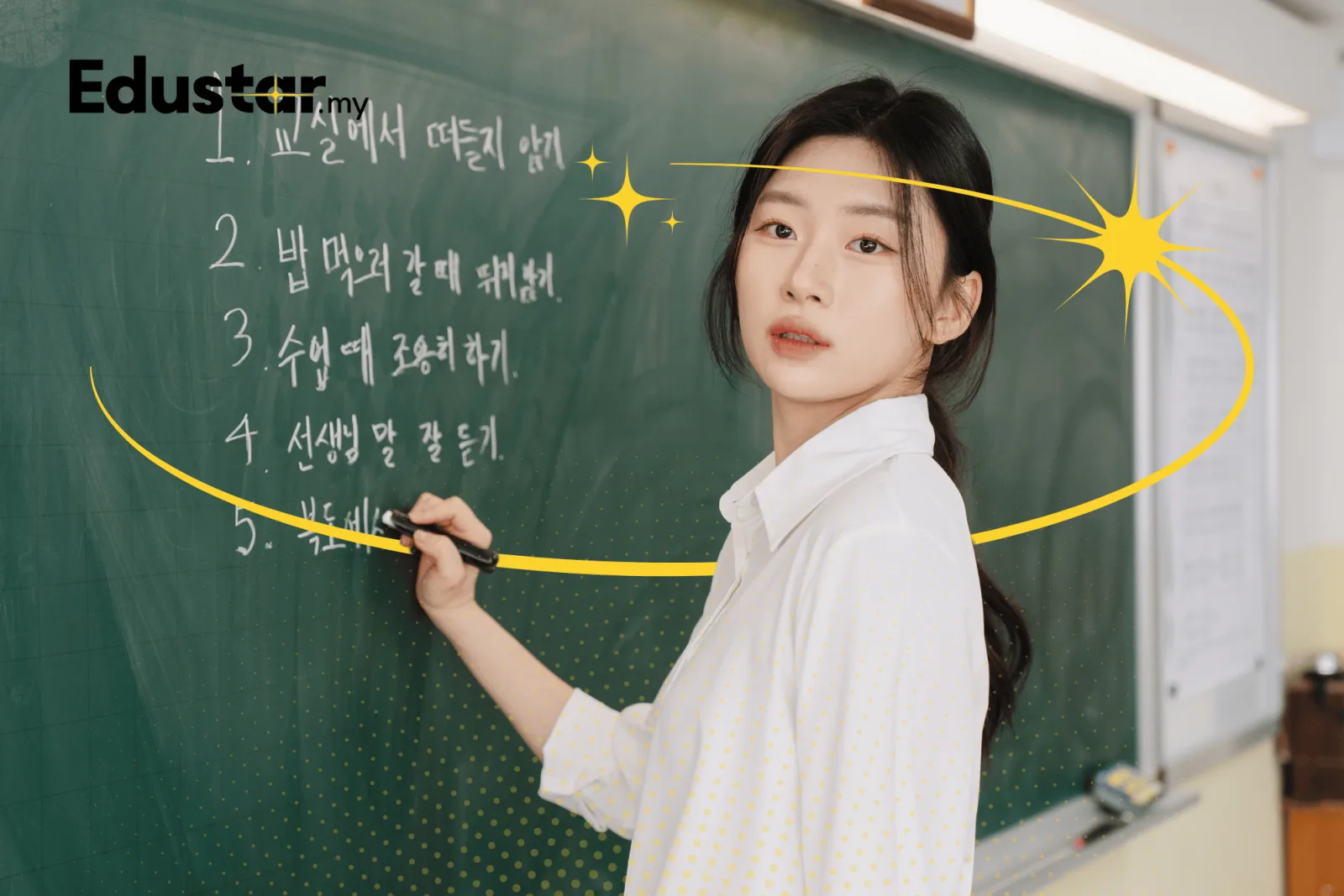
Korean (한국어 / Hangugeo) is the official language of the Republic of Korea, written in Hangul (한글), a 24-letter featural alphabet promulgated by King Sejong the Great in 1446 (Hunminjeongeum 훈민정음). Standardised proficiency is measured by TOPIK (Test of Proficiency in Korean), administered overseas by NIIED under the Korean Ministry of Education and held biannually in KL. TOPIK I covers Levels 1–2 (Beginner; Listening + Reading, 200 points), and TOPIK II covers Levels 3–6 (Intermediate to Advanced; Listening + Reading + Writing, 300 points). This Edustar course is the general adult & teen track that grounds learners from Hangul mastery (typically achieved in ~2 weeks of focused study, far faster than Japanese kana) through to TOPIK II Levels 5–6 for KOSAFA / Global Korea Scholarship (GKS) applicants, EPIK English-teacher-in-Korea aspirants, and business professionals at Samsung Electronics Malaysia (Cyberjaya), LG Electronics Malaysia (Petaling Jaya) and Hyundai-Sime Darby (Inokom, Kulim).
- 01Hangul (24 letters, Sejong 1446) mastered in ~2 weeks, faster than Japanese kana
- 02TOPIK I (Levels 1–2) targeted in ~4 months at 2 lessons / week
- 03TOPIK II (Levels 3–6) targeted in ~18 months with consistent practice
- 04King Sejong Institute KL curriculum compatibility for cross-enrolment
- 05KOSAFA / GKS scholarship and EPIK application prep included on request
- 06K-culture context (Hallyu, honorifics, K-drama register) woven into lessons
What we cover
Three modules mapped to NIIED TOPIK levels, plus optional KOSAFA / GKS and EPIK application tracks.
Module 1: Hangul + Survival Korean (TOPIK I, Levels 1–2)
Hangul mastery in 2 weeks, then survival Korean for travel, K-content comprehension and basic conversation. Cut-off targets: TOPIK Level 1 ≥80, Level 2 ≥140.
Hangul 24 letters (14 consonants + 10 vowels) with featural articulation; batchim (받침) final-consonant rules; syllable-block writing; numbers (native + Sino-Korean); particles 은/는, 이/가, 을/를; basic verbs and adjectives; -ㅂ니다 / -아요/어요 polite endings; greetings, family, food, time, directions; reading Hangul on K-drama subtitles and K-pop lyrics; TOPIK I past-paper drilling (Listening + Reading); ~1,500 word entry-level lexicon.
Module 2: Intermediate Korean (TOPIK II, Levels 3–4)
From scripted dialogue to spontaneous conversation. NIIED Levels 3–4 cut-offs: Level 3 ≥120, Level 4 ≥150. Writing paper introduced.
Honorific system (높임말 / 반말) and when each is socially appropriate; connective endings (-고, -아서/어서, -지만, -면서); past tense -았/었-, future intent -(으)ㄹ 거예요; irregular verbs (ㅂ, ㄷ, ㄹ, 으); reading Korean news (e.g. KBS, Yonhap clips), short essays and personal letters; TOPIK II Writing paper short-essay format (200–300자); K-drama and K-pop register vs textbook register; informal CEFR map: Level 3 ≈ B1, Level 4 ≈ B2.
Module 3: Advanced & Business Korean (TOPIK II, Levels 5–6)
Academic-style argumentation, business register, KOSAFA / GKS and EPIK application prep. NIIED cut-offs: Level 5 ≥190, Level 6 ≥230.
Sino-Korean vocabulary (한자어) for academic and legal registers; advanced grammar 더라도, -(으)ㄴ/는 만큼, -기는커녕; formal business Korean for Samsung / LG / Hyundai MY teams (회의, 보고서, 이메일); TOPIK II 600–700자 essay structure; KOSAFA / GKS personal-statement drafting; EPIK lesson-plan template and demo-lesson coaching; reading op-eds in Chosun Ilbo / Hankyoreh; informal CEFR map: Level 5 ≈ C1, Level 6 ≈ C2.
Things parents ask us first
TOPIK I vs TOPIK II: pick the right paper
TOPIK I (Beginner, Levels 1–2) is a 100-minute paper with Listening (40 questions) + Reading (40 questions), 200 points total. TOPIK II (Intermediate + Advanced, Levels 3–6) is a 180-minute paper that adds a Writing component (4 questions including a 600–700 character essay), 300 points total. Sit TOPIK I after Module 1; sit TOPIK II only after Module 2, the Writing paper trips early sitters. Held biannually in Malaysia (typically April + October) at the NIIED-partner KL test centre.
Hangul in two weeks: yes, really
Hangul has 24 base letters (14 consonants, 10 vowels) and is a featural alphabet, letter shape reflects how the sound is articulated. Most MY adult learners read Hangul aloud within ~10 days of focused study and recognise common words within 2 weeks. This is dramatically faster than Japanese (hiragana + katakana + entry-level kanji = ~6 months minimum) and Mandarin (~1,500 hanzi for basic literacy). Sejong's design goal in 1446 was a script that 'a wise man can learn in a morning, a foolish man in ten days', it largely holds true.
King Sejong Institute KL: free or subsidised tracks
King Sejong Institute Kuala Lumpur (세종학당 쿠알라룸푸르), under the King Sejong Institute Foundation since 2007, runs free or heavily subsidised Korean classes per term, often hosted with the Embassy of the Republic of Korea on Persiaran Stonor. Many of our students use KSI KL as a peer-cohort anchor and run Edustar 1-to-1 tuition in parallel for pace control, TOPIK exam drilling, and KOSAFA / EPIK application prep, the two complement, not compete.
Hallyu as study fuel (use it, don't apologise for it)
Korean-MY interest is driven by the Korean Wave (Hallyu, 한류) (BTS, BLACKPINK, Squid Game, Crash Landing on You) and that is a perfectly legitimate study motivator. Studies (Han 2022, Yim 2021) link sustained K-pop / K-drama engagement to faster vocabulary uptake and listening fluency. Our tutors lean into this: lyrics analysis, drama-clip transcription drills, fan-translation accuracy critique. Disclaimer: drama register ≠ TOPIK formal register; we teach both, not one.
EPIK has hard prerequisites: start prep early
EPIK (English Program in Korea), run by the Korean Ministry of Education, places native-English-speaking teachers in Korean public schools. Malaysian citizens are eligible if they hold a bachelor's degree taught in English (from an MQA-recognised university), a 100-hour TEFL/TESL/CELTA certificate, and apostilled documents. Korean language is not required at application, but TOPIK Level 3+ dramatically improves placement (urban vs rural) and stipend tier (KRW 1.8M–2.7M / month). Apply ≥6 months before intake; document apostille at Wisma Putra takes weeks.
Who this Korean course is for
Four real Malaysian learner profiles we match tutors to.
K-pop / K-drama fans (teens to 20s)
Secondary-school students and young adults whose study motivation is Hallyu: BTS, BLACKPINK, Stray Kids, Squid Game, Crash Landing on You. Goal: read Hangul lyrics, follow K-drama without subtitles, attend a Korean concert at Axiata Arena Bukit Jalil. Many sit TOPIK I as a personal milestone.
- Hangul recognition under K-drama subtitle speed
- Telling apart -ㅂ니다 (formal) vs -아요/어요 (polite) vs 반말 (casual)
- Honorific overwhelm when watching family dramas
- Translating fan-translation slang back into textbook Korean
KOSAFA / Global Korea Scholarship aspirants
Undergraduate or graduate applicants targeting study in Korea via NIIED's Global Korea Scholarship (GKS) or the Korea Foundation fellowship route. Most non-English programmes require TOPIK Level 3 (undergraduate) or Level 4 (graduate). Personal-statement and TOPIK Writing paper are the deciding components.
- TOPIK II Writing paper 600–700자 essay structure
- Reaching Level 4 from a standing start in <18 months
- Personal statement that reads natural in Korean
- Sino-Korean academic vocabulary (한자어)
EPIK English-teacher-in-Korea applicants
MY graduates with English-medium bachelor's degrees from MQA-recognised universities targeting EPIK placement in Korean public schools. TOPIK is not required at application but Level 3+ raises placement tier and stipend bracket (KRW 1.8M–2.7M / month). Application opens ~6 months before March / September intakes.
- 100-hour TEFL/TESL/CELTA cert sourcing in MY
- Apostille of MQA transcripts at Wisma Putra
- Demo-lesson video script in simple English + classroom Korean
- Survival Korean for first 3 months in Daegu / Busan / Gwangju
Korea-MY business professionals
Engineers, managers and account leads at Samsung Electronics Malaysia (Cyberjaya), LG Electronics Malaysia (Petaling Jaya), Hyundai-Sime Darby / Inokom (Kulim Hi-Tech Park), and KOTRA-listed Korean SMEs operating under the Korea-Malaysia FTA framework. Goal: read internal Korean memos, hold meeting small talk, build trust with Seoul HQ counterparts.
- Business email Korean (회의, 보고서, 이메일)
- Honorific calibration for HQ-vs-local seniority
- Reading internal docs in mixed Korean + English
- Drinking-culture (회식) etiquette and toasts
From first call to first lesson
How starting Korean tuition with Edustar works, and what the 4-month / 18-month milestones look like.
- 1
Free needs assessment
We ask: are you a Hallyu fan, KOSAFA / GKS applicant, EPIK applicant, or business professional? Target TOPIK level and timeline. Hangul status, fresh or already self-taught.
~15 min - 2
Hangul diagnostic
Tutor runs a 20-minute Hangul reading + listening check. Many K-pop fans already recognise Hangul from idol-name spelling, we do NOT assume zero. We slot you in at the right entry point.
Before lesson 1 - 3
Tutor matching
We match by track: TOPIK-experienced tutor for KOSAFA / GKS applicants, business-Korean tutor for Samsung / LG / Hyundai-MY staff, EPIK-aware tutor for teacher-track applicants, K-culture-fluent tutor for Hallyu-driven learners.
1–3 days - 4
Module 1: Hangul + Survival
Two 90-minute sessions per week. Hangul nailed in 2 weeks, then particles, polite endings, ~1,500 words. TOPIK I past-paper drilling from week 8.
Months 1–4 → TOPIK I - 5
Module 2: Intermediate (TOPIK II Levels 3–4)
Honorifics, connective endings, irregular verbs, news-clip listening, short-essay writing. Sit TOPIK II at month 12–14 targeting Level 3 or 4.
Months 5–14 - 6
Module 3: Advanced & Business / KOSAFA / EPIK
Sino-Korean academic vocabulary, 600–700자 essay, business register for HQ-Seoul calls, KOSAFA personal statement, EPIK demo-lesson coaching.
Months 14–22 → TOPIK II Level 5–6 - 7
Review and adjust
Quarterly checkpoint. Swap tutor (replacement guarantee) if chemistry is off; pivot pacing if TOPIK date moves; add cultural-immersion add-on before any KSI KL term or Korea trip.
Each quarter
Edustar 1-to-1 Korean vs King Sejong Institute vs tuition centre vs self-study
Four common ways MY learners pick up Korean: what each gets you, and what it doesn't.
Edustar 1-to-1 Korean
Best for
Learners with a TOPIK / KOSAFA / EPIK / business target and a deadline
TOPIK exam alignment
Direct: modules mapped to TOPIK I and TOPIK II cut-off scores
KOSAFA / GKS + EPIK prep
Yes: personal statement + lesson-plan + demo-lesson coaching
Pace and feedback loop
Full: slows on batchim, accelerates on K-drama register
Typical relative cost
Mid-to-premium per hour, no joining fee
King Sejong Institute KL (group class)
Best for
Learners who want a Korean-government peer cohort and cultural events
TOPIK exam alignment
Yes: KSI curriculum aligns to TOPIK Levels 1–4
KOSAFA / GKS + EPIK prep
Limited: referral guidance, not 1-to-1 application coaching
Pace and feedback loop
Fixed group pace per term
Typical relative cost
Free or heavily subsidised per term (limited seats)
Tuition centre (e.g. Berlitz, ELS)
Best for
Learners who prefer a structured fixed-syllabus group classroom
TOPIK exam alignment
Partial: depends on centre's syllabus choice
KOSAFA / GKS + EPIK prep
Rare: not the typical syllabus focus
Pace and feedback loop
Fixed group pace per term
Typical relative cost
Term-fee upfront, mid-range per hour
Self-study app (Duolingo + Talk To Me In Korean)
Best for
Casual K-pop / K-drama fans with 10 minutes a day
TOPIK exam alignment
None: no Writing-paper coaching
KOSAFA / GKS + EPIK prep
Not aligned
Pace and feedback loop
Self-paced; no correction loop
Typical relative cost
Free or ~RM30 / month subscription
Where Korean learning sits in the Malaysian career pathway
TOPIK I (1–2) → TOPIK II (3–4) → TOPIK II (5–6) → Korean MNC career or Global Korea Scholarship.
- 01
TOPIK I: Level 1–2 (beginner)
Hangul mastery, ~800 vocab, daily-life conversation. ~200 hours. Entry point for K-pop / K-drama enthusiasts.
- 02
TOPIK II: Level 3–4 (intermediate)
~2,000 vocab, news/work-context comprehension. ~600 hours cumulative. Entry-level requirement for Korean MNC roles in MY (Samsung, LG, Hyundai).
- 03
TOPIK II: Level 5–6 (advanced)
~5,000+ vocab, near-native fluency. Required for Korean-medium university degree (SKY: SNU/Korea/Yonsei) under Global Korea Scholarship (GKS).
- 04
Korean MNC career in MY
Samsung Penang, LG Display, Hyundai-Sime Darby, Korean-speaking liaison/sales/manufacturing-engineering roles. TOPIK 4+ standard hiring bar.
- 05
GKS scholarship / KIIP integration
Korean government scholarship for undergraduate or graduate study (full tuition + stipend). Or Korea Immigration & Integration Program for permanent residency track.
Frequently Asked Questions
Common questions from Malaysian Korean-language learners.
Start your Korean Language & Culture Course in Malaysia
Book a no-cost placement call and your Korean tutor is arranged within one to three days. Hangul in a fortnight, TOPIK I in ~4 months, TOPIK II in ~18 months. One-to-one across Malaysia or online.
- Free needs assessment
- TOPIK I and TOPIK II exam-aligned (NIIED cut-off scores)
- KOSAFA / Global Korea Scholarship + EPIK application coaching
- Native or near-native Korean tutors prioritised
- Replacement guarantee included
Edustar — Malaysian private tuition, KPM-aligned tutors.