Cycling Tuition in Malaysia
Cycling tuition in Malaysia teaches a rider to handle a bike safely and then to race it, moving up a seven-stage skill ladder: the push-bike balance and brake control of Stage 1-2, a committed road, mountain-bike, track or BMX specialism in Stage 3-4, and the pacing, cornering and sprint tactics of Stage 5-7. Riders who want to compete climb the school ladder run by MSSM Berbasikal (district MSSD, then state MSSN, then MSSM Kebangsaan at national level) before Sukma, PBM age-group racing and, for the few, the Le Tour de Langkawi peloton.
What is Cycling Tuition?
Cycling tuition in Malaysia is private, stage-by-stage coaching that runs road safety and racecraft side by side. The safety half starts with JPJ rules under the Akta Pengangkutan Jalan 1987 — a cyclist counts as a vehicle, a front white light and rear red reflector are required after dark, and a helmet is treated as compulsory in MSSM-sanctioned races and on most club rides even though adults are not yet forced to wear one on public roads. The racecraft half follows the discipline map set by PBM (Persekutuan Berbasikal Malaysia / Malaysian National Cycling Federation, MNCF, UCI federation code MAS, founded 1956): road (mass-start, criterium, time trial, gran fondo), track (sprint, keirin, individual pursuit, team pursuit, points race, omnium, Madison), mountain bike (XCO cross-country Olympic, DH downhill, enduro) and BMX (racing plus freestyle, Olympic since Tokyo 2020). A school-age racer first works through MSSM Berbasikal — district level (MSSD), state level (MSSN), then the national MSSM Kebangsaan — before Sukma (the biennial inter-state meet under KBS / MSN), PBM junior national age-group racing, and the MASOC / AKPS carded-athlete tiers (Olympic Podium / National Elite / Developmental), with centralised training on the boards of Nilai Velodrome (Velodrom Nasional Nilai, 250m wooden track, UCI Category 1) for track specialists or at Bukit Jalil National Sports Complex for the road squad. The benchmark every coach points to is Azizulhasni Awang — Olympic bronze in the Tokyo 2020 keirin, UCI Track World Champion in 2017, and the first Malaysian man to win a UCI cycling world title. Coaches are licensed through PBM Level 1, 2 and 3, all aligned to the KBS NCAS framework, and Edustar pairs each rider with a coach whose certificate and home venue suit the stage and discipline they are chasing.
- 01Every road, track, MTB and BMX championship in the country — junior, U17, U19, U23 and elite — is sanctioned by one body: PBM (Persekutuan Berbasikal Malaysia / MNCF, UCI federation code MAS), the sole national federation
- 02School racing climbs through MSSM Berbasikal across three rungs — district MSSD, state MSSN and national MSSM Kebangsaan — split into Year 4-6 primary and Form 1-5 secondary categories, with road race, time trial and MTB XCO on the programme
- 03Le Tour de Langkawi (LTdL) is the UCI ProSeries multi-stage road race that has run annually since 1996 (paused 2020-21 for COVID), covering ~1,400-1,800 km of Peninsular Malaysia on Astro Arena + RTM Sukan; it is the spectator-to-club funnel that recruits Malaysian road riders
- 04Nilai Velodrome (Velodrom Nasional Nilai) is a 250m wooden indoor track rated UCI Category 1 since 2015; it hosted the UCI Track World Cup 2016 and a UCI Track Nations Cup, and the carded national track squad trains there full-time
- 05Choosing a discipline early shapes everything — road wants traffic sense plus an endurance base, MTB wants technical handling and time on the Bukit Kiara / FRIM / Putrajaya / Cameron trails, track wants Nilai access and fixed-gear nerve, BMX wants a Putrajaya Challenge Park or local skate-park to ride
- 06When you check a coach, ask for the certificate number, not the badge: a PBM Level 1 / 2 / 3 coaching cert, a KBS NCAS credential (National Coaching Accreditation System, Levels 1-3) under MyMaster Coach, and a UCI Coach Diploma for the elite-track end
- 07JPJ enforces the Akta Pengangkutan Jalan 1987: a cyclist is a vehicle, keeps to the leftmost lane in single file on highways, obeys the lights, and runs a front white light plus rear red reflector at night — with a helmet strongly advised and treated as compulsory in MSSM and on club rides
- 08The pathway's MY reference is Azizulhasni Awang — Olympic bronze in the Tokyo 2020 keirin, silver at Rio 2016 and UCI World Champion in the 2017 keirin, the first Malaysian man to take a UCI cycling world title — who trained partly at the Australian Institute of Sport and Nilai Velodrome
- 09KPM's PJK (Pendidikan Jasmani dan Kesihatan) and SEGAK cover cardiovascular fitness but set no cycling-competence standard, so with most MY schools running no cycling programme at all, private coaching fills the gap
- 10MTB venues to know: Bukit Kiara (KL urban-edge, ~30 km of trail, free), FRIM Kepong in Selangor (technical XC through jungle, RM 5-10 entry), Putrajaya Challenge Park (the SEA Games 2017 XCO venue), Cameron Highlands (long enduro and DH at Brinchang / Sungai Palas), and Bukit Cerakah Shah Alam (beginner loops)
- 11The easiest way in for adults is KL Car-Free Sunday — a DBKL initiative since 2014, held the first Sunday of each month, closing Jalan TAR, Dataran Merdeka and KLCC from 7-9am with free bicycle loan stations — built for first-time and family riding
Who Cycling tuition in Malaysia is for
The coach and the venue are chosen around where the rider stands today: balance-bike beginners aged 4-7, school-age MSSM hopefuls, adult riders on the KL Car-Free Sunday circuit, and weekend MTB enthusiasts.
Kids 4-7 — balance bike + first pedal-bike (Stage 1-2)
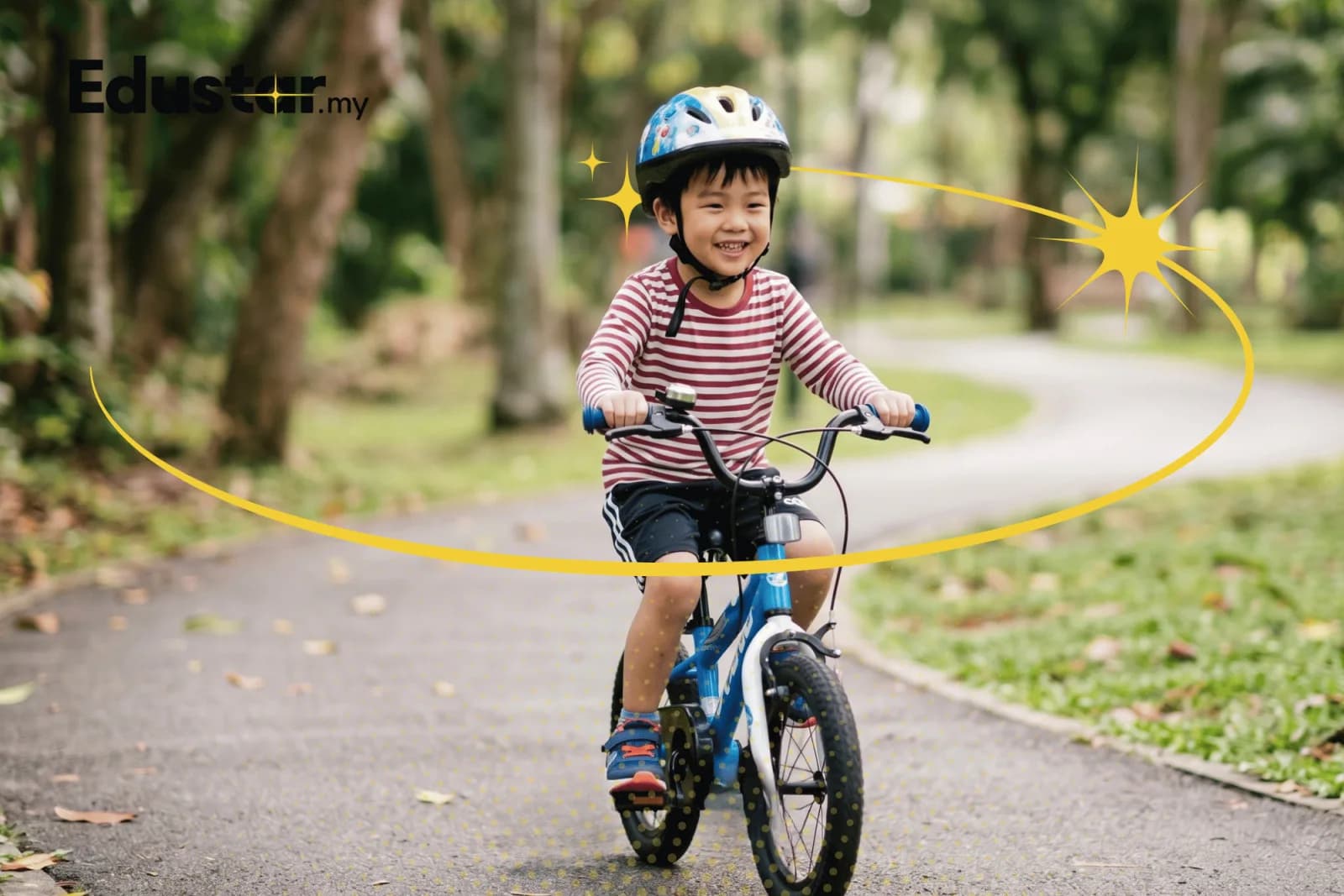
A first taste of cycling for pre-school and lower-primary children. Many begin on a balance bike at age 3-4 (no pedals, feet on the ground) and move to a pedal bike around age 5-6. The coaching builds balance and steering, controlled braking (rear lever first, then front, never grabbing the front alone), an eyes-up habit of looking down the road, a simple sense of gears on geared bikes, and a correctly fitted helmet every single ride. Children from national schools, SJK(C) and SJK(T), private kindergartens and homeschooling families all fit here. The goal is a continuous 5-10 km on safe ground — a condo road, a park, Putrajaya Boulevard or KL Car-Free Sunday — with a parent watching.
- Child fears falling — won't take both feet off the ground or coast
- Family bike available but parent isn't a confident cyclist themselves
- School has no cycling programme; KPM PJK syllabus doesn't deliver competence
- Mixed-traffic environment at home (no condo park / safe road) — child can't practice
School-age MSSM aspirants (Year 4-6 + Form 1-5)
A primary- or secondary-school rider aiming for MSSM Berbasikal. Already at ease on the bike and good for 10-20 km, this rider now needs discipline-specific drilling — usually road race, time trial and MTB XCO at MSSM level — plus pacing and cadence work, a grasp of the MSSM event formats (50m / 100m / 200m sprints, road race, TT and MTB XCO), the state qualifying marks, and the shift from riding for fun to riding against the clock. Most have their first crack at district MSSD around Year 4-5. The goal runs from a state-team place at MSSN to MSSM Kebangsaan starts and an SBP sports-scholarship shortlisting.
- Can ride 20 km but no structured training plan; FTP and zones never measured
- Keen to enter MSSD Berbasikal yet unsure of the qualifying time standards and the event format
- Lacks discipline-specific drilling — vague between road, MTB and track
- School cycling team (if any) is recreational; no PBM-credentialled coach on deck
Adult recreational (KL Car-Free Sunday + Klang Valley club rides)
An adult rider — maybe a complete beginner who found cycling at KL Car-Free Sunday, a returner rebuilding fitness, or a Strava-curious commuter chasing a first gran-fondo (Cycle Malaysia, Bentong Climb Challenge, OCBC Cycle Malaysia). The coaching sets a proper bike fit (seat height, reach, stack), builds pacing and zone-2 endurance, and rebuilds cornering and descending nerve — usually the biggest fear after a crash — while drilling group-ride etiquette, JPJ road discipline and a training plan pointed at the target event. Most reach a continuous 50 km in 8-16 weeks of weekly sessions and a 100 km gran-fondo in another 3-6 months, often alongside KL Cyclones or Le Tour Club Malaysia membership.
- Bought a road bike, did one or two solo rides, felt overwhelmed by traffic and fitness gap
- Joined a club ride but got dropped on the climbs; embarrassed to return
- Wants to ride OCBC Cycle Malaysia or Bentong Climb Challenge but no idea how to train
- Older adult returning after years off the bike; bike-fit is uncomfortable and they don't know what to adjust
MTB enthusiasts (Bukit Kiara / FRIM / Putrajaya / Cameron)
A mountain-bike rider — at school or grown up — pulled in by the Bukit Kiara urban-edge network, the FRIM jungle XC, the Putrajaya Challenge Park XCO course or the long Cameron Highlands enduro and downhill runs. The coaching works on body-bike separation, reading a line through technical ground, log-overs and step-downs, drop technique, switchback cornering and a solid descending stance, then the MTB XCO race format itself (staggered start, 4-6 laps, technical sections mixed with climbs). Because MTB XCO sits on the MSSM programme, serious riders chase MSSN qualifying, then MSSM Kebangsaan, then a Sukma state team.
- Crashed on a Bukit Kiara descent and lost confidence; needs to rebuild technical handling
- Wants to race MTB XCO at MSSM but no race-format coaching available locally
- Can ride Bukit Kiara loops but stuck at the same lap time — no structured technique work
- Cameron Highlands enduro / DH trips are intimidating without a guide-coach
What cycling coaching covers
Three modules across the cycling journey — Foundations (balance, braking, gears, traffic safety), Discipline-specific (road / MTB / track / BMX), Advanced (race tactics + MSSM time-qualifying + PBM selection + LTdL aspiration).
Foundations — Stage 1-2 (balance, braking, gears, traffic safety, kids 4-7 + first-time adult)
Take a child or adult from never-ridden to comfortably covering 5-10 km on safe routes. The work starts on a balance bike or a pedal bike and builds controlled braking, an early feel for gear-shifting, and the JPJ road-rule and helmet habits a MY rider needs before sharing a lane with traffic. By the close of Stage 1-2 the learner pushes off and stops cleanly, holds 5-10 km without a break, shifts gears at the right moment, and settles into an easy group at KL Car-Free Sunday pace.
Stage 1: balance-bike fundamentals (4-5 year olds typically start here; no pedals, feet propel, develops balance + steering); pedal-bike transition usually age 5-6; mounting and dismounting safely; gentle controlled braking (squeeze the rear first, then front — never grab the front lever alone); pushing off and stopping; eyes-up looking ahead not at front wheel; basic gear awareness on geared bikes. Stage 2: 5-10 km continuous ride at ~12-15 km/h; cadence introduction (target 70-90 RPM); gear-shifting under load (anticipate hills, shift before grinding); proper hand positions on flat / drop / MTB bars; signalling (left arm out for left turn, right arm out for right turn, vertical arm raised for stop); JPJ road-rule brief — Akta Pengangkutan Jalan 1987 cyclists are vehicles + leftmost lane + single file + front white light + rear red reflector at night; helmet fit and adjustment (the universal MSSM + club requirement); pre-ride bike check (M-check: tyres + brakes + chain + seatpost + handlebar). KL Car-Free Sunday first group ride as graduation event.
Discipline-specific — Stage 3-4 (road / mountain bike / track / BMX, Year 1-6 + MSSM primary entry)
Commit to one discipline and go deep. Road, mountain bike, track and BMX each ask for a different bike, a different skill set, a different venue and a different race format. The coach drills the technical core — descending, cornering and climbing for road; line choice, log-overs and drops for MTB; the fixed-gear standing start for track; pump-track lines for BMX — alongside the pacing and on-bike fuelling that separates a real rider from a passenger.
Road — descending technique (outside-pedal-down weighting + inside-knee-out for cornering); cornering lines (apex on entry, accelerate out); climbing seated and standing (cadence + body position); group-ride etiquette (drafting, paceline rotation, hand signals for hazards: holes, gravel, slow); time-trial pacing (negative split or even-pace per UCI TT doctrine); long-ride nutrition (40-60g carbs/hour after 90 min); training-route catalogue around Klang Valley — Genting Sempah, Bukit Damansara, Putrajaya Boulevard. Mountain Bike — body-bike separation (let bike pivot under you over rough terrain); line choice on Bukit Kiara / FRIM / Putrajaya Challenge / Cameron trails; log-over and step-down technique; drop technique (chest forward then weight back); switchback cornering; descending stance (heels down, hips back); MTB XCO race format briefing — staggered start, 4-6 laps, technical sections + climbs. Track — Nilai Velodrome introduction (250m wooden boards, 42-degree banked turns); fixed-gear discipline (no freewheel, no brakes — cannot coast); standing start; flying lap pace; race events (sprint, keirin paced behind derny then sprint, individual pursuit, team pursuit, points race, omnium, Madison hand-sling exchange). BMX — Putrajaya Challenge Park or local skate-park access; pump-track technique (no pedalling, pump with arms-and-legs through transitions); manuals and wheelies; jumps with controlled landing; BMX racing format (8-rider gates, 4 laps, banked corners, jumps). Stage 4 includes first MSSM Berbasikal MSSD (district) entry — typically Year 4-6 road race + time trial + MTB XCO events. Bike-fit baseline (seat height, reach, stack) before drilling — wrong fit slows progression.
Advanced — Stage 5-7 (MSSM Kebangsaan + Sukma + PBM age-group + LTdL aspiration)
Move from a capable rider to one who can hit MSSM Kebangsaan qualifying times, make a Sukma state team, enter PBM junior national racing and earn a look from the senior MASOC / AKPS carded programme. Expect race-specific conditioning, FTP testing, sprint work, tactical race-reading, and the multi-year periodisation that turns a club racer into a national development prospect.
FTP (Functional Threshold Power) testing — 20-minute all-out × 0.95 = FTP estimate; structured power-zone training (Z1 recovery, Z2 endurance, Z3 tempo, Z4 threshold, Z5 VO2max, Z6 anaerobic, Z7 neuromuscular sprint); sprint training (standing start sprints, flying sprints, micro-bursts). Race-tactics — when to attack (rolling terrain into headwind), when to chase (only with form + numbers), when to sit (paceline 2nd or 3rd wheel for finish), sprint lead-out structure, breakaway selection logic. Discipline-specific tactics: ROAD — peloton positioning + crosswind echelon + bunch-sprint lead-out + climb pacing + LTdL stage-race aspiration (multi-day GC management, recovery, queen-stage attack); MTB XCO — start-line sprint to single-track entry, lap-pacing, technical-section recovery, descending under fatigue; TRACK — keirin tactics (where to be at 3 laps to go), pursuit pacing (negative-split aerobic), team-pursuit changes, points-race intermediate sprints + lapping the field. PBM age-group entry pathway — junior, U17, U19, U23 categories with time-qualifying standards + race-result-based selection. Sukma state-team selection runs on a biennial cycle. MSSM Kebangsaan time-qualifying study per event. Taper plan for the target meet (usually 7-14 days, lower volume while intensity is held). Strength + conditioning periodisation (heavy off-season, maintenance in-season). Sports-nutrition (carb-loading, race-day fuelling, recovery protein 20-30g within 30 min). Sports-psychology (race visualisation, breakaway commitment, finish-line discipline). Reference: Azizulhasni Awang's Olympic-podium pathway via Nilai Velodrome + Australian Institute of Sport — the Pocketman blueprint. Para-cycling classification awareness if relevant (C1-C5 cycling, H1-H5 hand-cycle, T1-T2 tricycle, B vision-impaired tandem).
From first call to first ride
How starting Cycling tuition with Edustar works — PBM-credentialled coach, venue-matched route, stage-progression diagnostic.
- 1
Free needs assessment (Day 0)
Tell us the rider's age and how far along they are now (a balance-bike beginner, good for 5 km, able to take on 20 km of hills, or already chasing the MSSM track), plus the goal (safe independent riding, fitness, a first MSSM-primary entry, a Sukma state team, PBM junior racing, turning from LTdL spectator to rider, or a Para-cycling classification), the preferred discipline (road, MTB, track or BMX), the venue that suits you (home neighbourhood, KL Car-Free Sunday, Bukit Kiara, FRIM, Putrajaya Challenge, Nilai Velodrome or Cameron Highlands) and your free days. We give you an honest read on how long each stage genuinely takes.
~15 min - 2
Stage diagnostic — first ride session assessment
In the first 60-90 minutes the coach runs a Stage 1-7 diagnostic on a real ride — what the rider can do unaided, a bike-fit check (seat height, reach, stack), a braking-and-cornering audit, the gear-shifting habit, a cadence baseline and how familiar the rider is with JPJ road rules. It usually lands the rider half a stage below where they thought they were, which is normal. Out of that comes a three-month plan: a weekly focus and a measurable test for leaving each stage.
First session - 3
Coach matching (credential + discipline + venue + temperament)
Now we pair the rider with a coach whose credentials suit the stage, the discipline and the target. Stage 1-3 foundations need a PBM Level 1 minimum; MSSM-track Stage 4-5 adds PBM Level 2 with KBS NCAS Level 2; Sukma, PBM national and Para-cycling carded track call for PBM Level 3 with a UCI Coach Diploma. The coach is matched to discipline (road for road, MTB for trails, track for Nilai, BMX for Putrajaya Challenge) and to venue (home neighbourhood, KL Car-Free Sunday, Bukit Kiara, FRIM, Putrajaya, Nilai, Cameron). Temperament counts too: a calm pace for an adult still shaky after a crash, brisk energy for a competitive youngster.
1-3 days - 4
First focused session — stage anchor + skill priority
The first real session locks onto the single biggest gap the diagnostic found. Stage 1-2 children work on balance-bike confidence, brake-lever discipline and a proper helmet fit. Stage 3-4 builds a discipline baseline — a road cornering line, MTB body-bike separation, the track standing start, or BMX pump-track technique. Stage 5-6 brings FTP testing and a power-zone introduction; Stage 7 racers drill race tactics and sprints. The rider leaves with clear homework for the week — a solo ride logged on Strava, or pump-track practice.
Session 1 - 5
Weekly drilling — technique + endurance + safety
Sessions run weekly at 60-90 minutes, stretching to 90-120 for competitive riders, and each one moves through three kinds of work. There is technique at the current stage — isolation drills for cornering, climbing, descending or sprinting; there is distance and pace, stepping up 10 km, 25 km, 50 km and 80 km with power-zone sets once the rider races; and there is safety and craft — JPJ rules, group-ride etiquette and roadside mechanics like a puncture repair, a chain reset and a basic gear adjustment. Between sessions the rider does one or two solo rides to build distance and an aerobic base.
Ongoing — weekly - 6
Competitive prep — MSSD / MSSN / MSSM Kebangsaan / Sukma / PBM cycles
With 8-12 weeks left before a target meet, the work turns race-specific. The rider builds power-zone conditioning matched to the event distance, retests FTP, trains sprints, drills race tactics and, where it is possible, recons the actual course. A taper is planned — usually 7-14 days into the meet — and the coach walks through the race-day routine of warm-up rollers, recovery between events, fuelling and mental rehearsal. The MSSM and Sukma formats get their own coaching: heats and finals, time controls, venue logistics and the technical sign-on.
Final 8-12 weeks pre-meet - 7
Post-meet review + next-cycle planning
In the week after the meet the coach goes through the ride data (power profile, lap splits, how the rider exited corners, how the sprint picked up, where they finished) and sets the priority for the coming three to six months. The multi-year plan is updated: district MSSD this year, state MSSN next, MSSM Kebangsaan and Sukma trials the year after, PBM junior age-group by Form 6. Para-cycling classification is reviewed again where relevant, and the coach remains available across the PBM age-group selection windows and the Sukma trials.
1 week post-meet
Things parents ask us first
Pick the discipline early — road vs MTB vs track vs BMX needs different bikes, venues and training rhythms
Cycling is really four sports under one name. Road riding rewards a traffic-safety habit, a drop-bar bike with 22-24 gears, and an endurance base laid down on long Klang Valley routes like the Genting Sempah climb and the Putrajaya Boulevard loop. Mountain biking asks for technical handling, a hardtail or full-suspension MTB, and steady miles on the Bukit Kiara, FRIM, Putrajaya Challenge and Cameron Highlands trails. Track means getting to Nilai Velodrome, learning a fixed-gear bike with no freewheel and no brakes, and holding your nerve on banked wood. BMX runs on a single-speed bike, a Putrajaya Challenge Park or skate-park, and pump-track technique. A young rider can roam across all four until age 11-12, but a serious MSSM-track hopeful settles on a primary discipline by Year 4-5 because each qualifying ladder stands on its own. Edustar gives you the plain truth about what each one demands before we match a coach.
PBM coach licensing tiers — Level 1, 2, 3 + KBS NCAS — verify by number, not by claim
PBM (Persekutuan Berbasikal Malaysia) grades its coaching certificate in three tiers. Level 1 is the community and club-entry coach, solid for Stage 1-3 foundations and basic technique. Level 2 is the state-team junior coach, good through Stage 4-5 and the first MSSM-track build-up. Level 3 is the national elite coach for Sukma, national age-group and carded-athlete work. All three sit inside the KBS NCAS (National Coaching Accreditation System) framework under MyMaster Coach, with the UCI Coach Diploma as the international ticket held by senior elite coaches. The practical move: ask for the PBM certificate number and the KBS NCAS number rather than accepting 'PBM-coached' as a claim. Each Edustar coach holds a PBM Level 1 and a KBS NCAS Level 1 as the floor, rising to Level 2/3 plus a UCI Diploma for the MSSM-track and Sukma-prep coaches, and we name that credential when we match you.
Azizulhasni Awang's pipeline is the realistic blueprint — MSSM → Sukma → PBM junior → carded → AIS attachment
Azizulhasni Awang — 'The Pocketman' — is the name every MY junior with big cycling ambitions looks to. His climb went from a school-age track introduction to Sukma junior, PBM junior national, an MSN AKPS carded-athlete place, a long-term attachment at the Australian Institute of Sport, and then Olympic bronze in the Tokyo 2020 keirin, Olympic silver at Rio 2016 and the UCI Track World Champion title in the 2017 keirin — the first Malaysian man to win a UCI cycling world title. Parents deserve the plain version: that road takes 12-15 years of structured training from age 8-10, needs a carded-athlete place by the mid-teens, and is wildly unlikely to end at an Olympic medal. Yet the structure itself — an MSSM Kebangsaan medal at Form 1-3, a Sukma state team at Form 4-5, PBM junior national at Form 6 or Pre-U, an AKPS Developmental place at university — is within reach of hundreds of MY juniors a year, and the Pocketman proves the Olympic ceiling is real. Edustar coaches will tell you honestly which tier is realistic for the rider in front of them.
JPJ road rules + helmet discipline — non-negotiable from Day 1
The Akta Pengangkutan Jalan 1987, enforced by JPJ, counts a cyclist as a vehicle. In practice that means the leftmost lane, single file on highways, obeying every traffic signal, a front white light and rear red reflector after dark (PDRM and JPJ both enforce it), and never riding against the flow. A helmet is strongly advised for adults on public roads and is simply compulsory in MSSM Berbasikal sanctioned races, on PBM club rides, on every KL Car-Free Sunday group ride and at most ride-clubs (Trek Bicycle Store, Specialized KL, Le Tour Club Malaysia). For children it is non-negotiable from balance-bike Stage 1 — an Edustar coach will not coach a child whose helmet does not fit properly. Other kit for the road: a cycling jersey or visible top (high-vis at dawn and dusk), gloves advised, and eye protection for MTB and against insects on long road rides. Lights must be set up before any night riding.
KL Car-Free Sunday is the gateway for adult-onset cyclists — start there, then graduate to club rides
DBKL has run KL Car-Free Sunday since 2014 — the first Sunday of each month, with the Jalan TAR, Dataran Merdeka and KLCC zone closed to traffic from 7-9am and free bicycle loan stations at the start points. It is the gentlest possible entry to MY urban cycling: no traffic risk, a warm crowd of recreational riders, and a family-friendly pace. An adult usually moves through it like this: two or three Car-Free Sundays to build confidence and settle a bike-fit baseline, then a structured club ride (Le Tour Club Malaysia, KL Cyclones, Putrajaya Bike Riders) over 30-50 km at 25-28 km/h, then Edustar one-to-one coaching to sharpen technique and add a training plan once gran-fondo events are the goal (Cycle Malaysia, Bentong Climb Challenge, OCBC Cycle Malaysia). The annual Le Tour de Langkawi broadcast on Astro Arena and RTM Sukan is the cultural anchor that pulls fresh viewers into the sport every March.
What Cycling tuition with Edustar covers
Honest scope: no guaranteed podium finishes, only structured year-round coaching across Stage 1-7 and aligned to the MSSM / Sukma / PBM / LTdL pipeline.
Age 4 – adult
Stages we coach, from balance-bike Stage 1 to race-pace Stage 7
Road / MTB / Track / BMX
Discipline lines mapped to the PBM and UCI taxonomy
MSSM + Sukma + PBM
Race ladders — school MSSD and MSSN, national MSSM Kebangsaan, Sukma, then PBM junior and senior age-group
Nationwide
Where we ride — KL Car-Free Sunday, Bukit Kiara, FRIM, Putrajaya, Nilai Velodrome, Cameron
Edustar 1-to-1 cycling coach vs Klang Valley cycling club vs DBKL public sports centre vs self-instructed YouTube + parents
Four routes into cycling in Malaysia. Each carries a genuine use case, though 1-to-1 PBM-credentialled coaching supplies the diagnostic layer the others miss.
Edustar 1-to-1 cycling coach
Format
Weekly 1-to-1 (or 1-to-2 for siblings), held at whatever venue the family prefers, running all year with the target tuned to the rider's Stage 1-7 position and MSSM track
Diagnostic depth (catches technique errors early)
Coach reviews every ride; recurring errors (poor cornering line, late braking, wrong gear) caught session 1-3
Discipline-specific drilling (road / MTB / track / BMX)
Coach matched to discipline + venue; full Stage 3-4 + Stage 5-7 depth in chosen primary discipline
Coach credential (PBM / KBS NCAS / UCI)
PBM Level 1 minimum; Level 2/3 + KBS NCAS Level 2/3 for MSSM-track + Sukma-prep coaches; UCI Coach Diploma for elite
Per-session cost (MYR)
RM 80-200 per 1-to-1 session + venue fee (Nilai Velodrome lane, FRIM entry) separate
Match to MY pathway (MSSM / Sukma / PBM)
Built around MSSM time-qualifying standards, the Sukma state-team trial format, and PBM junior national entry
Best for
Stage 3-7 discipline-specific drilling, MSSM time-qualifying preparation, nervous adult beginners, and the Para-cycling track
Parent visibility + reporting
A weekly WhatsApp note plus a monthly stage-progression review drawing on video clips, power data and ride logs
Klang Valley cycling club (Le Tour Club / KL Cyclones)
Format
Weekly club ride of 20-80 riders, set route + pace group, member fee + ride etiquette expected
Diagnostic depth (catches technique errors early)
Limited — ride leader's attention split across 20+ riders; technique feedback mostly informal at café stops
Discipline-specific drilling (road / MTB / track / BMX)
Usually road-focused (some MTB-specific clubs in KL); single-discipline per club
Coach credential (PBM / KBS NCAS / UCI)
Mixed — club ride leader may or may not be PBM-certified; ask before joining
Per-session cost (MYR)
RM 50-200 annual membership; ride day usually free for members + café cost
Match to MY pathway (MSSM / Sukma / PBM)
Some clubs run junior-development squads with PBM ties (Le Tour Club Malaysia); most are recreational
Best for
Stage 4-5 social road riding, adult fitness, gran-fondo group training, KL Car-Free Sunday post-graduate
Parent visibility + reporting
Strava + club WhatsApp group; minimal structured reporting on the rider's progression
DBKL public sports centre group session
Format
Periodic group session at DBKL sports complex, batch-based, often free or token fee
Diagnostic depth (catches technique errors early)
Variable — depends on session leader credential; basic only
Discipline-specific drilling (road / MTB / track / BMX)
Generic — road basics only at most public sports centres
Coach credential (PBM / KBS NCAS / UCI)
Variable — DBKL session leaders often not formally PBM-certified
Per-session cost (MYR)
Often free or RM 5-15 venue entry; cheapest end of market
Match to MY pathway (MSSM / Sukma / PBM)
Stage 1-3 foundations only, with no MSSM-track or race-competitive preparation in the syllabus
Best for
Stage 1-2 first-time exposure on a tight budget; family bike day combined with token session
Parent visibility + reporting
Usually no structured reporting; parent attends and observes
Self-instructed YouTube + parents
Format
Self-paced YouTube + parent on bike, no formal curriculum or diagnostic
Diagnostic depth (catches technique errors early)
No structured diagnostic; the parent only spots what they already recognise
Discipline-specific drilling (road / MTB / track / BMX)
Whatever a given YouTube channel happens to cover, often fragmented and mixed across disciplines
Coach credential (PBM / KBS NCAS / UCI)
Parent's own cycling background; no formal coaching credential
Per-session cost (MYR)
Free (YouTube + family bike access); equipment cost only
Match to MY pathway (MSSM / Sukma / PBM)
Rests wholly on whatever the family assembles from publicly available information
Best for
Stage 1-2 balance-bike for very young child with a confident-cyclist parent; not for serious technique
Parent visibility + reporting
Whatever the parent records and reviews
Frequently Asked Questions
Common questions from Malaysian cycling parents, adult learners and competitive cyclists.
Start Cycling tuition with Edustar
Free needs assessment + PBM-credentialled cycling coach matched within 1-3 days. Stage 1-7 across road / MTB / track / BMX, MSSM Berbasikal + Sukma + PBM age-group + LTdL pipeline, nationwide.
- Free needs assessment plus a stage diagnostic in the opening session
- PBM Level 1-3 / KBS NCAS / UCI Coach Diploma credentialled coaches
- Venue-matched: KL Car-Free Sunday, Bukit Kiara, FRIM, Putrajaya Challenge, Nilai Velodrome, Cameron
- Stage 1-7 sequenced curriculum + MSSM / Sukma / PBM prep when ready
- Nationwide — Klang Valley, Penang, Johor, East Malaysia coverage
Edustar — Malaysian private tuition, KPM-aligned tutors.