Volleyball Tuition in Malaysia
Volleyball coaching in Malaysia pairs one player with one coach across two games at once — the indoor six-a-side court and the two-a-side beach game. A MAVA-certified coach (Malaysia Volleyball Association, FIVB code MAS) carries you from club sessions through the U-12 / U-15 / U-18 school championships, into a state junior squad, on through Sukma, and toward AVC Junior, SEA Games and FIVB Beach Tour play.
What is Volleyball Tuition?
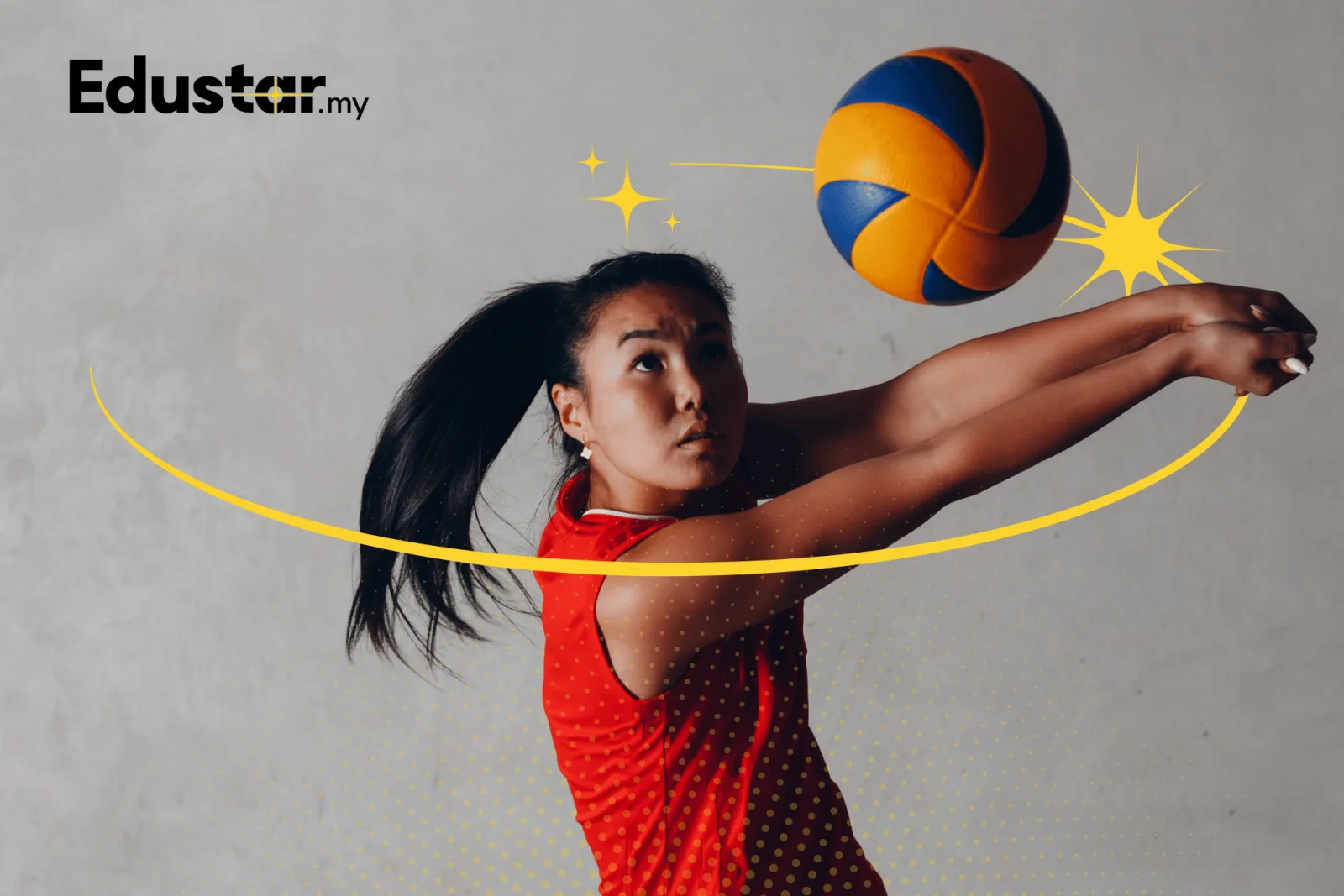
Volleyball coaching in Malaysia runs all year and pulls in two directions at once: two games and two ambitions. The two games are the indoor six-a-side court (six players a side with named roles — setter, outside hitter, opposite, middle blocker, libero; a fixed rotation; rally scoring to 25 with a deciding set to 15; the libero substitution rule) and the beach two-a-side game (two players a side with no specialist roles — each must serve, receive, set and attack; a sand court of 8×8 m per side; rally to 21 with a deciding set to 15; no libero and no substitutions; a block counting as one of the three touches). On the recreational and foundation side, children (usually from age 7) and adult beginners learn the grammar every volleyball player shares — the forearm pass (the bump) off a flat platform, the overhead set with the fingers spread, the standing float serve, the jump and topspin serves, the attack approach (three steps, left-right-left for a right-hander; four steps once it is advanced), the spike (high contact above the net, a wrist snap, the arm finishing across the body), the receive (a low platform aimed at the target zone), and the read-block or soft-block at the net. On the competitive side the route is the one the Malaysia Volleyball Association (MAVA / Persatuan Bola Tampar Malaysia, FIVB country code MAS, AVC full member) lays out: club work with MAVA-certified coaches (the MAVA Coach Education tiers — Level 1 Community, Level 2 Club, Level 3 High Performance — built on the FIVB coaches commission framework), then the schools climb through MSSM Bola Tampar (Malaysia School Sports Council) rising from district (MSSD) to state (MSSN) to national (MSSM Kebangsaan) across the U-12, U-15 and U-18 boys' and girls' categories, then Sukma (Sukan Malaysia, the every-other-year state games run by KBS / MSN) and selection into a MAVA state under-18 or under-20 squad. For the strongest juniors the peak is a place at the AVC Asian Junior Championship (U-18 and U-20), a MAVA national U-18 / U-20 call-up, and a spot in the KBS / MSN NSC Volleyball Academy at Bukit Jalil. The senior peak is the MAVA national side at the AVC Asian Senior Championship, the AVC Cup and the SEA Games — Malaysia has staged SEA Games volleyball six times (1965, 1971, 1977, 1989, 2001, 2017), and a fair regional yardstick is the men's bronze won in 1977 KL and the women's fourth place, with the gold owned by Thailand on the women's side and Indonesia on the men's. The beach ceiling abroad is the FIVB Beach Volleyball World Tour (with past Malaysian stops at Langkawi, Putrajaya, Port Dickson) and the AVC Beach Tour. Edustar reads each player's stage, chosen game (indoor or sand) and best position, then puts a coach beside them who fits that exact point on the road.
- 01MAVA — the Malaysia Volleyball Association, also Persatuan Bola Tampar Malaysia, FIVB country code MAS and an AVC full member — is the country's only volleyball federation; it owns the MAVA Coach Education tiers (Level 1 Community, Level 2 Club, Level 3 High Performance, built on the FIVB coaches commission framework), runs the National Volleyball League, and fields the senior men's and women's sides plus the junior U-17 / U-19 / U-21 squads
- 02The schools climb under MSSM Bola Tampar moves up one rung at a time — win your district (MSSD), then your state (MSSN), then play for a national MSSM Kebangsaan medal — and it runs every year in three age bands: U-12 for primary Year 4-6, U-15 for Form 1-3, U-18 for Form 4-5, boys and girls alike, all of it indoor six-a-side under FIVB rules, a school joining simply by registering its sukan-stream team with nothing to pay at the district round
- 03Two games, two training plans: indoor six-a-side (six players, the specialist roles of setter / outside / opposite / middle / libero, a rotation, rally scoring to 25 with a deciding set to 15, the libero substitution rule) and beach two-a-side (two players, no specialist roles, sand halves of 8×8 m, rally to 21 with a deciding set to 15, no libero or substitutions, a block that counts as a touch) — the ceilings differ, yet each sharpens ball-control the other can borrow
- 04AVC — the Asian Volleyball Confederation — is the continental authority and Malaysia sits in it as a full member; MAVA national squads turn up at the AVC Asian Senior Championship (men + women), the AVC U-18 / U-20 Asian Junior Championship, the every-other-year AVC Cup and the AVC Beach Tour, where the honest Malaysian target is the qualifying rounds (Iran / Japan / China / South Korea rule the men's draw, China / Thailand / Japan the women's)
- 05At the SEA Games, where both indoor six-a-side and beach two-a-side are played, Malaysia has been host six times (1965 / 1971 / 1977 KL / 1989 / 2001 KL / 2017 KL); the men's high-water mark stays the 1977 KL bronze and the women's a fourth place, Thailand collects the women's gold, Indonesia the men's, and the Philippines is climbing — so a realistic Malaysian aim is the medal fight rather than gold
- 06Sukma (Sukan Malaysia, the state-versus-state games held every two years under KBS / Kementerian Belia & Sukan and MSN / National Sports Council) is the crossing point between a school player with an MSSM medal and a place in a MAVA state under-18 or under-20 squad — both the indoor and the beach game are on the Sukma programme
- 07The indoor six-a-side roles each ask for their own drill diet — the Setter (court vision, steady hands, quick decisions, the on-court leader), the Outside Hitter (left-side attacker who plays all six rotations and must both pass and hit), the Middle Blocker (centre-net reader, quick attacker, fast lateral feet), the Libero (back-row defensive specialist in the odd jersey, never attacking, unlimited substitutions, the platform-passing master), and the Opposite or right-side hitter (right-side attacker, often the chief point-scorer, who blocks the rival outside)
- 08The three indoor systems sit on a ladder of complexity — 5-1 (one setter, five attackers, the modern competitive standard most MSSM Kebangsaan medal teams run), 4-2 (two setters in opposite rotations, four attackers, the simpler set-up common in school U-12 / U-15 sides), and 6-2 (two setters who also attack from the front row, six attackers in all, with a trickier transition)
- 09The KBS / MSN NSC Volleyball Academy at Bukit Jalil is the central home of the national squads, junior and senior; a player usually reaches it the same way each time — through a MAVA state elite squad, then a national U-18 / U-20 trial, then academy intake
- 10NACMP — the National Athletes' Career and Education Programme under KBS / MSN — helps MAVA-selected student-athletes juggle SPM, STPM, MUET, Matrikulasi and IPT study against full national training; it is a working pathway, not a slogan
- 11The FIVB Beach Volleyball World Tour, which has stopped in Malaysia at Langkawi, Putrajaya and Port Dickson, is the international beach ceiling; the two-a-side sand game is a sensible move for indoor players whose reach or position limits their indoor future, and plenty of Malaysian pros keep both games going at once
Who Volleyball tuition in Malaysia is for
The coach and the intensity are set to where the player truly is: kids 7-12 on foundations, school-age MSSM hopefuls, adult recreational 6-aside crowds, and MAVA-pathway competitive juniors.
Kids 7-12 — beginner foundations
First exposure to volleyball as a structured sport. The child can already throw and catch and has the basic coordination to handle a ball at shoulder height; coaching focus is forearm-pass platform (locked elbows, thumbs together, knees bent), overhead-set finger-pad contact (no palm hitting), standing float serve mechanics (stiff hand, no wrist snap on contact), the receive (low athletic posture, platform angle to target), attack-approach footwork (three-step left-right-left for right-handers), and the ten basic rules. Suitable for children in national, Chinese-medium (SJK(C)), Tamil-medium (SJK(T)), private and homeschool settings. Often paired with school-team play. Goal: enjoy the game, develop coordination + reflexes + vertical, optionally enter MSSD U-12 school competition by Year 4-5.
- Child loves volleyball but swings the platform through the ball on every pass — never learned the platform-angle discipline
- Sets with palms not finger pads — produces a double-contact fault every other rally
- Standing serve never reaches over the net at U-12 height — wrong contact point and wrist motion
- A school team exists, but it is mixed-ability with no structured individual technique work, mostly free-ball scrimmage
School-age MSSM aspirants (Form 1-5)
Already plays in school + MSSD events at U-15 or U-18 level, may have reached MSSN (state). Has a school-team teacher-coach but wants 1-to-1 diagnostic to break the plateau and project the right position 2-3 years out (setter vs outside vs middle vs libero vs opposite). Coaching focus: position-specific role drilling, 5-1 / 4-2 / 6-2 system rotation literacy, serve-receive formation (W / U / two-person), FIVB-tempo conditioning, opponent-specific tactical patterns. Goal: MSSM Kebangsaan medal, Sukma state-squad selection, MAVA state-association elite junior squad, national U-18 / U-20 + AVC Junior consideration.
- Stuck at MSSN quarter-final level — wins simple matches but loses to better-passing opponents in the deciding set
- Position is unclear — was the school's tallest in Year 6 so got drilled at middle blocker, but is only 178 cm at Form 4 and should be on the outside
- Approach footwork hesitates on step two — spike contact is below the net height, attack efficiency flat for two seasons
- Has heard of MSSM Kebangsaan, AVC Junior and MAVA national U-18, yet sees no clear route up from the current MSSN level
Adult recreational 6-aside players (working professionals + parents)
Plays 1-3 times per week at a township court, club hall or industrial-park sports complex, often after work or weekend mornings. Picked up the ball either as a school-age junior who stopped at SPM and returned to the sport, or as an AVC / FIVB-fan adult-onset player seeking fitness. May want to improve form for the social ladder or simply play injury-free into the 40s. 4-aside and 6-aside social leagues at Klang Valley industrial sports halls are the typical competitive entry point. Coaching focus: forearm-pass platform retraining (the biggest single gap for adult recreational players), set-with-finger-pads discipline, standing float serve consistency, shoulder rotator-cuff prehab (volleyball-shoulder injury is the dominant chronic volleyball injury).
- Plays 2x per week but pass accuracy flat for years — platform discipline never installed, sets are always emergency-set
- Shoulder injury risk rising — overhead motion without proper rotator-cuff conditioning, especially at jump-serve practice
- Cannot run a clean 5-1 rotation with social-league friends — rotation order confusion, nobody knows who is allowed to attack from where
- Watches AVC and the FIVB Volleyball Nations League each week on Astro, yet struggles to turn any of it into real on-court application
MAVA-pathway competitive (state-squad track + beach 2v2 pivot)
Already in or aiming for the MAVA state-association elite junior squad (under-15, under-17, under-18, under-20). May come from MSSM Kebangsaan medal background, an SBP sukan-stream school (Sekolah Sukan Bukit Jalil + Sekolah Sukan Tunku Mahkota Ismail), or an MRSM Sukan intake. Coaching focus: position consolidation, 5-1 + 6-2 fluency at AVC tempo, late-set scenario reps, individual attack bag expansion (line + crosscourt + cut + tool), defensive read at AVC tempo, parallel beach 2v2 cross-training (FIVB Beach Tour standard). Goal: MAVA national U-18 / U-20 selection, AVC Asian Junior Championship representation, NSC Volleyball Academy intake at Bukit Jalil, with beach pivot as parallel ceiling.
- Plays bench role at MAVA state under-17 — needs to expand individual attack bag (line + crosscourt + cut + tool) to claim starting rotation
- Defensive read breaks down at AVC tempo — block-and-pull timing inconsistent, perimeter defence positioning slow
- Vertical reach capping indoor middle-blocker ceiling at 290 cm — needs to consider beach 2v2 pivot where vertical matters less
- NACMP juggle — SPM workload + state-squad training + selection-camp travel needs coach support to plan term-by-term
What volleyball coaching covers
Three modules across the volleyball journey. Foundations (pass + set + serve + receive, age 7-12 or first-time adult), Tactical play (5-1 / 4-2 / 6-2 system + rotation + position-specific drills for setter / outside hitter / middle blocker / libero / opposite, MSSM-track Form 1-3), and Competition track (MSSM tournament prep + MAVA selection + beach 2v2 pivot, Form 4-5 + elite juniors). Each module usually spans 12 weeks with one or two 1-hour sessions a week, benchmarked to MAVA / MSSM / Sukma standards.
Foundations — pass, set, serve, receive (age 7-12 + first-time adult)
Build the four pillars every volleyball player needs before any position or system work. Universal coaching canon — the forearm pass, the overhead set, the standing float serve and the receive. Suitable for primary-school kids (Year 1-6) and complete-beginner adults of any age. 12-week module.
Forearm pass (bump) using the platform — straight arms, locked elbows, thumbs together, knees bent, platform angled at the target zone, no swinging through; pass-to-target accuracy (target the setter's zone 3 on the net); overhead set with finger spread — ball contact on finger pads not palms, equal pressure both hands, wrist snap follow-through, set to outside-hitter zone 4 and to opposite zone 2; standing float serve — toss flat, contact ball at full extension with stiff hand, no follow-through wrist snap (produces the float / knuckle-ball wobble); progress to topspin serve and jump serve only after the standing float is consistent; receive (pass) discipline — read the server, low athletic posture, platform angle to target, never swing through the platform; attack-approach footwork — three-step (left-right-left for right-handers; right-left-right for left-handers) and four-step variant; spike mechanics — high contact above the net, wrist snap, follow-through across the body, no net contact; read-block and soft-block fundamentals at the net (penetration without crossing the net plane); the ten basic rules every kid should know first (three-touch rule, no double-contact except on first ball, no net contact, no foot fault on serve, rotation order, libero substitution rule, rally scoring, set point and deuce, FIVB out-of-bounds line, ceiling rule); FIVB junior court geometry (9×18 m, 2.43 m men's net + 2.24 m women's net + 2.20 m U-15 girls + 2.10 m U-12); first MSSD U-12 school volleyball entry pathway for primary kids.
Tactical play — 5-1 / 4-2 / 6-2 system, rotation, position-specific drills (Form 1-3 MSSM track)
Build the position-specific role discipline and the team-system literacy needed for MSSM (MSSD → MSSN → MSSM Kebangsaan) school competition and MAVA-affiliated club tournament play. Coaches drill the five-position role canon and walk through the three-system rotation logic. 12-week module.
Position 1 (Setter / S) — hand-setting consistency from every court position, jump-set decision-making, back-set to opposite zone 2, dump kill in front court, court vision and leader role on every rotation, defensive dig from zone 1; Position 2 (Outside Hitter / OH, also called Left-Side) — six-rotation player so must pass + attack equally, pass platform discipline (Outside is the primary serve-receive target), four-step attack approach in zone 4, line shot and crosscourt shot reading the block, back-row attack from zone 6 / zone 5; Position 3 (Middle Blocker / MB) — quick attack (1-tempo, slide attack), read-block at the net (read the setter, jump with the outside hitter), lateral footwork along the net, soft-block when out-of-system; Position 4 (Libero / L) — back-row defensive specialist, distinct jersey, unlimited substitution into back row, no attack above the net height, platform-pass master, defensive read on the spike (zone 5 dig + zone 1 dig + zone 6 dig), serve receive as primary passer; Position 5 (Opposite / OP, also called Right-Side) — right-side attacker from zone 2 + back-row from zone 1, often the main point-scorer, blocks the opposing outside hitter, jump serve and aggressive attack profile; system canon — 5-1 (one setter front-row or back-row depending on rotation, five attackers, the modern competitive standard most MSSM Kebangsaan medallist teams run); 4-2 (two setters in opposite rotations, both setters front-row in their respective rotations, four attackers — the simpler system common at MSSD / MSSN U-12 and U-15 level); 6-2 (two setters who attack from front row, six attackers overall, more complex transition with the setter coming from back row); rotation reading — track the rotation number, identify which players are eligible to attack from the front court, libero substitution timing; team defence basics — 6-back defence (libero zone 6), perimeter defence vs middle-up defence, weak-side dig reads, free-ball / down-ball read; serve receive formation — W-formation, U-formation, two-person serve receive (Libero + one Outside Hitter, the modern standard); FIVB timing awareness (rally scoring to 25, deciding set to 15, two-point gap, libero substitution rule, three-touch rule); MAVA-affiliated club entry pathway.
Competition track — MSSM tournament prep + MAVA selection + beach pivot (Form 4-5 + elite juniors)
Push from MSSN state-medal contender to MSSM Kebangsaan medal, state U-17 / U-18 / U-20 squad selection, and the parallel beach 2v2 pivot. The coach calibrates tactical patterns to the AVC and FIVB Beach Tour standard, walks the student through the MSSM Kebangsaan → AVC Junior + Sukma → MAVA national U-18 / U-20 → NSC Volleyball Academy pipeline, and adds beach 2v2 cross-training. 12-week module.
Set-play library (indoor 6v6): quick attack family (1-tempo middle quick, slide attack to zone 4, X-shot crossing combination, tandem combination), back-row attack (pipe attack from zone 6, D-attack from zone 1), back-set to opposite jump serve combination; against-block tactics — line shot vs crosscourt shot vs cut shot vs roll shot vs tool the block (controlled deflection off the blocker's hands out of bounds); defence — read-block patterns (read the setter, read the hitter, jump with the hitter not the ball), drop-blocker into perimeter defence, swing block footwork (lateral crossover); end-of-set scenarios — set point routine, deciding set side-switch at 8 points, time-out usage, lineup-decision late in the set; physical conditioning — sport-specific interval training (vertical jump priority, lateral plyometrics, shoulder rotator-cuff prehab — volleyball-shoulder injury is the dominant volleyball injury); opponent video analysis using AVC broadcast, FIVB Volleyball Nations League broadcast (for system reference), and MSSM Kebangsaan video where available; tournament-day routine — warm-up sequence (pepper drill + serve-receive reps + spike approach + block jumps), hydration, between-set reset, anti-tilt mental reset following a missed serve run; MSSM Kebangsaan format and FIVB-rule awareness; Sukma (Sukan Malaysia) state-squad selection process; MAVA state-association elite junior pathway; AVC Asian Junior Championship (U-18 / U-20) selection expectation; MAVA national U-18 / U-20 trial expectation — what selectors look for (vertical reach, position fit, technique stability, mental durability); NSC Volleyball Academy at Bukit Jalil intake; **beach 2v2 cross-training** — beach attack mechanics differ from indoor (cut shot + line shot dominate, no quick attack, no back-row D), beach defensive read (block-and-pull, defender shading), beach serve toss (more variable for wind), sand-conditioning (sprint + jump in sand stresses shoulders / ankles differently); FIVB Beach Tour and AVC Beach Tour entry pathway; NACMP context for student-athletes balancing SPM / STPM workload with national training.
From first call to first volleyball coaching session
How starting Volleyball tuition with Edustar works — diagnostic first, pass + set + serve + receive sequencing second, position-specific + system drilling third.
- 1
Free needs assessment (Day 0)
Tell us the player's age and where they stand now (complete beginner, casual, a school-team regular, an MSSD-MSSN player, or an MAVA-affiliated club competitor), their current MSSM Bola Tampar ranking or school-team role, a height projection (parent and sibling heights help here), the target track (recreational fitness, an MSSM medal, Sukma selection, national U-18/U-20 and AVC Junior, the NSC Volleyball Academy, or a pivot to the FIVB Beach Tour), the preferred discipline (indoor 6v6, beach 2v2, or both), and the training time free each week. We give an honest read on what that timeframe can realistically deliver.
~15 min - 2
Diagnostic — pass + set + serve + footwork + match video review
The coach studies the player on court for 30-45 minutes in person, or works through 2-3 recent game and drill videos online. Diagnostic focus: forearm-pass platform (elbow lock, thumb alignment, platform angle to target, no swinging through), overhead-set contact (finger pads not palms, equal hand pressure, wrist snap follow-through), standing float serve (stiff hand at contact, no wrist snap, toss height), receive footwork (low athletic posture, platform angle), attack approach (three-step left-right-left timing, spike contact height vs net), position fit (current school position vs projected position at Form 4-5 given height + frame + skill profile + hand vs platform talent), volleyball IQ (rotation reading, three-touch discipline, defensive read). The goal here is to isolate the 3-4 recurring patterns the rest of the plan will then work on.
Before lesson 1 - 3
Coach matching (MAVA cert level + position specialism + discipline)
We pair the student with a coach tuned to their level, target track, projected position and preferred discipline. MAVA Level 1 (Community) coaches suit first-time kids and recreational adults; MAVA Level 2 (Club) covers MSSD / MSSN competitive juniors; MAVA Level 3 (High Performance) for MSSM Kebangsaan + Sukma + AVC Junior + NSC academy elite. We also match position specialism — setter-development coach for setter projects, libero-development coach for libero projects, hitter-development coach for outside / opposite projects, middle-blocker-development coach for middle blocker projects — and discipline (indoor 6v6 specialist vs beach 2v2 specialist vs cross-trained both). In-person across Klang Valley, Penang, Johor; online video-review sessions nationwide.
1-3 days - 4
First lesson — foundations + plan anchor
The coach fixes on a single structural decision to carry the next 3-6 months. For beginners: pass-platform + set-finger-contact + standing-float-serve installation sequence. For MSSD / MSSN juniors: position projection + which 2-3 position-specific drills to anchor + which system (5-1 / 4-2 / 6-2) the school team runs. For MAVA-track elite juniors: individual attack bag expansion + 5-1 rotation fluency + parallel beach 2v2 cross-training plan. For adult recreational: platform-retraining sequence and shoulder rotator-cuff prehab. That first lesson sets both the baseline and the direction of travel.
Lesson 1 - 5
Weekly drilling — pass + set + serve + position-specific + system rotation
Sessions run weekly for 1-1.5 hours, split three ways: (a) foundations drilling — pass-to-target platform reps + finger-set contact reps + standing float serve consistency + receive footwork; (b) position-specific drilling — the 3-4 priority drills from the diagnostic, e.g. setter hand-set from every court position + jump-set decision, outside-hitter pass-and-attack continuity + line / crosscourt shot reading, middle-blocker quick attack + lateral read-block, libero serve-receive + zone 5 + zone 6 + zone 1 defensive dig, opposite back-row attack + opposing-outside block; (c) system + tactical application — 5-1 / 4-2 / 6-2 rotation walk-through with read cues, pipe-attack situational reps, end-of-set scenario. Between sessions: 15-20 daily minutes of wall-passing and serve-toss reps at home, plus 1-2 rounds of supervised match play.
Ongoing — weekly - 6
Tournament prep — MSSM / Sukma / MAVA cycles
In the 4-8 weeks ahead of a target tournament (MSSD / MSSN, MSSM Kebangsaan U-12 / U-15 / U-18, state-association junior open, Sukma trial, MAVA-affiliated club tournament, FIVB Beach Tour qualifier), attention turns to tournament-specific preparation: opponent video study, an FIVB-rule walk-through (rally scoring to 25, deciding set to 15, libero substitution rule, three-touch rule, foot fault on serve), conditioning timed to the real match format, late-set scenario reps (set point + deuce + side-switch at 8 points in the deciding set), a pre-event physical taper, intensified shoulder rotator-cuff prehab, and a briefing on the tournament-day routine (a warm-up sequence built on the pepper drill + serve-receive reps + spike approach + block jumps, hydration, between-set reset, anti-tilt mental routine).
Final 4-8 weeks pre-event - 7
Reviewing the tournament and mapping the next cycle
Inside a week of the tournament, the coach goes through every match video together with the student, pinpointing what the coming 3-6 months should work on: a platform that breaks under fatigue, a position-specific drill the opponent exploited, a rotation-order leak in the deciding set. The multi-year plan is then updated: MSSD U-12 this year, MSSN U-15 next, MSSM Kebangsaan and a first state-squad call the year after, then Sukma, AVC Junior and MAVA national U-18 for the exceptional. Coaches remain on hand for MAVA state-association selection windows, FIVB Beach Tour pivot decisions, and any technical questions between tournaments.
1 week post-event
Things parents ask us first
Indoor 6v6 vs beach 2v2 — two disciplines, one MAVA pathway
In Malaysia volleyball is really two sports under one roof. The indoor six-a-side game puts six players a side with set roles — setter, outside, opposite, middle and libero — a rotation, rally scoring to 25 (deciding set to 15) and the libero substitution. The beach two-a-side game strips that back to two players who each serve, receive, set and attack, on sand halves of 8×8 m, rally to 21 (deciding set to 15), with no libero, no substitutions and a block that counts as a touch. Both answer to MAVA (Malaysia Volleyball Association, FIVB code MAS) and feed the same MAVA-coach ladder. Indoor is the school game — every MSSM Bola Tampar title is contested six-a-side — and the main line into the MAVA state junior squads. Beach is its own ceiling: the FIVB Beach Tour (past Malaysian stops at Langkawi, Putrajaya, Port Dickson) and the AVC Beach Tour. Many MAVA pros play both, and the sand game is a realistic switch for indoor players whose reach or position caps their indoor road.
Pass-set-serve before spike — the standard MAVA-certified coaching sequence
The commonest fault in self-taught Malaysian players is falling in love with the spike too early. They want to hammer the ball like the AVC pros on Astro before they own a steady forearm platform, a clean overhead set or a serve that lands. A MAVA-certified coach flips the order to foundation-first: pass to the target (platform angled, never swung through), set off the finger pads (no palms, a wrist-snap finish), the standing float serve (a stiff hand, no wrist snap, producing the knuckle-ball wobble that steals points at any level), then the receive (the libero's craft), then the three-step approach, and only after all of that, the spike. A side where everyone passes, sets and serves cleanly runs 5-1, 4-2 and 6-2 without stalling; a side built around one hitter but soft in reception loses to better passers as early as the district round. Most junior sessions spend 50-60% of their time on pass, set, serve and receive, not on hitting.
Position fit matters — setter / outside / middle / libero / opposite demand different drill plans
Five positions, five different drill priorities. A 170 cm guard-build prospect with quick hands and court vision needs to live in setter drill space — hand-setting from every court position, jump-set decision-making, back-set to opposite, defensive dig from zone 1 — and is wasting reps on middle-blocker work. A 175 cm passing specialist with low athletic platform and fast feet should be groomed as libero — distinct jersey, back-row defensive read, serve-receive as primary passer — not pushed to attack. A 185 cm tall lateral mover with quick approach should be middle blocker — quick attack, read-block at the net, lateral footwork. A 180 cm strong-armed left-handed prospect should be opposite — right-side attacker, often the main point-scorer. A 178 cm six-rotation player who can pass + attack is the outside-hitter profile. Insisting every tall kid play middle (the typical school-team default because they were tallest in Year 6) wastes opposite-hitter and setter ceilings. A MAVA-certified coach reads height, frame, athletic profile and hand skill, then projects position 2-3 years out, then drills accordingly — buying a position-specific drill plan instead of one-size-fits-all is the structural value 1-to-1 coaching adds.
MSSM Bola Tampar is the MY school-volleyball gold pathway — open to every MY school
Malaysia School Sports Council (MSSM) runs annual volleyball championships at U-12 (Year 4-6), U-15 (Form 1-3) and U-18 (Form 4-5) levels, boys + girls, across three stages: MSSD (Daerah / district), then MSSN (Negeri / state), then MSSM Kebangsaan (national). Any government, vernacular or private school with a volleyball team can enter at MSSD level through school registration, with no entry-fee gate. Format is indoor 6v6 under FIVB rules. National (MSSM Kebangsaan) medallists are regularly shortlisted for the SBP (Fully Residential School) sukan-stream and MRSM Sukan intake, for the state-association elite junior squads feeding Sukma, and for the MAVA national U-18 / U-20 squad sent to the AVC Asian Junior Championship. A coach who knows the MSSM format (FIVB rules, three-set + best-of-five-set match length depending on category, rally scoring to 25, deciding set to 15, libero substitution rule) and the seeding logic adds value beyond pure technical strength.
Sukma + KBS / MSN NSC Volleyball Academy — the bridge from MSSM to MAVA national
Sukan Malaysia (Sukma, biennial inter-state games under KBS / Kementerian Belia & Sukan and MSN / National Sports Council) is the structural bridge between MSSM Kebangsaan medal contention and MAVA senior national consideration. Both indoor 6v6 and beach 2v2 are contested. State-association elite junior squads (under-18 / under-20) train year-round, contest Sukma, and feed the MAVA national U-18 / U-20 trial pool. The MAVA selectors at the national U-18 / U-20 trial typically draw from Sukma state-squad participants. Intake into the KBS / MSN NSC Volleyball Academy at Bukit Jalil — the centralised national-squad training infrastructure — typically follows: MAVA state-association elite squad → national U-18 / U-20 selection → academy intake. NACMP (National Athletes' Career and Education Programme) sits alongside, supporting selected student-athletes who must also navigate SPM, STPM, MUET, Matrikulasi or IPT workloads in parallel.
School volleyball team + public sports centre group + beach community pickup — none of them give you the diagnostic eye
Modern Malaysian volleyball families commonly stack three layers: the school sports-unit (sukan + ko-kurikulum) volleyball team, a Saturday-morning group class at the local sports centre (Setia Alam, Bandar Sunway, Mont Kiara, Bangsar South), and a beach 2v2 community pickup at PD / Bagan Lalang / Port Dickson on weekends. Each layer has value: the school team gives indoor 6v6 match reps, the group class gives baseline drills, and beach pickup gives ball-control reps in a different format. What none of them give is the diagnostic eye that catches the same recurring platform-angle leak week after week, the curriculum sequencing (when to install 5-1 rotation reads and when to defer them), and the candid post-session feedback that says 'your approach footwork is hesitating on step two, and that is why your spike contact is below the net'. Edustar 1-to-1 MAVA-certified coaching supplies the diagnostic layer the other three cannot; many students keep the school team and community pickup for match reps and add a weekday 1-to-1 session for technique work.
What Volleyball tuition with Edustar covers
An honest scope: we promise no MSSM medal, only steady year-round coaching aligned to MAVA, MSSM, Sukma, AVC and FIVB benchmarks.
Age 7 – adult
Levels supported (beginner foundations to MAVA-pathway competitive)
Indoor 6v6 + beach 2v2
Disciplines (FIVB indoor + FIVB Beach Tour cross-training)
MAVA + MSSM + Sukma + AVC
Tournament tracks (MSSD → MSSN → MSSM Kebangsaan U-12 / U-15 / U-18 + Sukma + AVC Junior + MAVA national U-18 / U-20)
Nationwide
In-person across Klang Valley / Penang / Johor + online video review
Edustar 1-to-1 MAVA-certified coach vs school volleyball team vs public sports centre group vs beach community pickup
Four routes through improving at volleyball in Malaysia. Most serious players blend several, though 1-to-1 MAVA-certified coaching supplies the diagnostic layer the others miss.
Edustar 1-to-1 MAVA-certified coach
Format
Weekly 1-to-1 coaching, year-round, MAVA / MSSM / Sukma / AVC / FIVB Beach Tour target customised per student
Diagnostic depth (catches recurring mistakes)
The coach reviews each session and match video; recurring platform-angle / approach-footwork / set-contact-point faults surface within 3-4 sessions
Pass + set + serve curriculum (foundation priority)
Drilled weekly — platform discipline + finger-set contact + standing float serve + receive footwork, video-review of pass-to-target accuracy
Per-hour cost (MYR)
RM 80-200 / hr, set by the coach's MAVA certification tier (Level 3 / High Performance at the top end)
Match to MY pathway (MAVA / MSSM / Sukma / AVC / FIVB Beach Tour)
Tuned to the MSSM format, Sukma state-squad selection, the MAVA state-association elite junior track, AVC Junior, and NSC Volleyball Academy intake
Best for
Kids 7-12 after a structured foundation; Form 1-5 players on the MSSM track; serious juniors aiming at MAVA national U-18 / U-20, AVC Junior, Sukma and NSC academy
Parent visibility (primary and secondary players)
A weekly WhatsApp update plus a termly milestone review (pass accuracy, position fit, tournament results, vertical reach)
School volleyball team (sukan / ko-kurikulum)
Format
School-team training 2-3x per week during MSSM Bola Tampar season, mixed-ability scrimmage-heavy, indoor 6v6 only
Diagnostic depth (catches recurring mistakes)
Limited: one coach-cum-teacher handles 12-15 kids at once, with the focus on team tactics ahead of individual technique
Pass + set + serve curriculum (foundation priority)
Covered at the start of pre-season; rarely diagnosed individually mid-season
Per-hour cost (MYR)
Effectively free for the school team, though no individual coaching is built in
Match to MY pathway (MAVA / MSSM / Sukma / AVC / FIVB Beach Tour)
Strong where the school runs a sukan-stream programme (SBP, MRSM Sukan); weaker at a standard SMK
Best for
Every school-age kid chasing competitive indoor 6v6 match reps inside the MSSM ladder
Parent visibility (primary and secondary players)
Occasional teacher-coach notes through the parent-teacher channel, plus MSSM result reports
Public sports centre group class
Format
Weekly 1-1.5 hr group of 10-20 mixed-ability kids, station drills + scrimmage, indoor only
Diagnostic depth (catches recurring mistakes)
Limited — coach can only catch the most obvious errors across 10-20 kids at once
Pass + set + serve curriculum (foundation priority)
Covered superficially at the start of each session; rarely diagnosed individually
Per-hour cost (MYR)
RM 30-60 per session (1-1.5 hr); RM 120-240 / month typical
Match to MY pathway (MAVA / MSSM / Sukma / AVC / FIVB Beach Tour)
Foundation only — feeds into school team but rarely into MSSM Kebangsaan medal contention
Best for
First-exposure for ages 5-10; ongoing fitness layer for any age
Parent visibility (primary and secondary players)
End-of-session informal coach feedback; periodic group-class report card
Beach community pickup (PD / Bagan Lalang)
Format
Weekend social 2v2 / 4v4 pickup on sand, no curriculum, no coach
Diagnostic depth (catches recurring mistakes)
Zero — peer feedback only, mistakes calcify
Pass + set + serve curriculum (foundation priority)
Almost never — players free-ball to keep the rally going, no platform discipline
Per-hour cost (MYR)
Free — but beach venue parking + own gear required
Match to MY pathway (MAVA / MSSM / Sukma / AVC / FIVB Beach Tour)
Direct exposure to beach 2v2 format — useful as cross-training but no pathway integration alone
Best for
Adult recreational 6-aside + 4-aside crowd; indoor players cross-training for beach 2v2 pivot
Parent visibility (primary and secondary players)
None — parent sees TikTok highlights, not real progress
Frequently Asked Questions
Common questions from Malaysian volleyball parents, school-age players, MAVA-pathway aspirants and adult improvers.
Start Volleyball tuition with Edustar
Free needs assessment, then a volleyball coach matched within 1-3 days. MAVA-certified coaching, the MSSM school pathway, the Sukma / AVC Junior / NSC Volleyball Academy pipeline, indoor 6v6 and beach 2v2, available across the country in person or by online video review.
- Free needs assessment + pass / set / serve / approach-footwork / match-video diagnostic
- Coach matched by MAVA certification level (Level 1 / 2 / 3) + position specialism + indoor / beach discipline
- Sequenced curriculum: pass + set + serve + receive → position-specific → 5-1 / 4-2 / 6-2 system → tournament tactics
- MAVA / MSSM / Sukma / AVC Junior tournament prep (MSSD → MSSN → MSSM Kebangsaan → Sukma → national U-18 / U-20 → AVC Junior)
- Home or online — nationwide
Edustar — Malaysian private tuition, KPM-aligned tutors.